


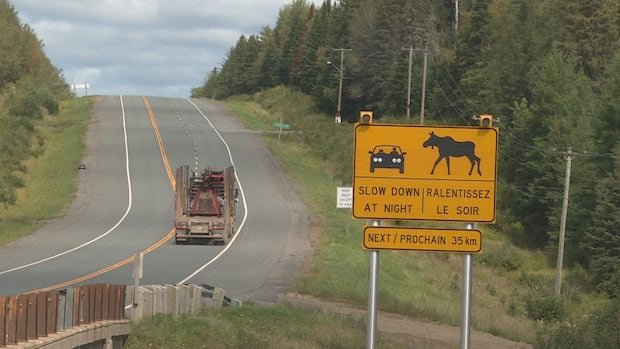

On a late August Saturday night, the Chaleur Lightning hockey team finished an exhibition game against the Miramichi Timberwolves and was traveling back to Bathurst on their team bus. Assistant coach Alex Ouellet recalled a moment when the driver suddenly gasped only five minutes into the journey. Looking up, Ouellet saw a shape ahead, followed by a loud bang as the bus collided with a moose on the highway. Fortunately, everyone on board, except for the driver who sustained minor scratches, escaped unharmed. The incident left a lasting impression on Ouellet and the team, who will now be more cautious when traveling those roads, especially at night.
Coincidentally, during that same week, the province announced the addition of two new wildlife crossings along that highway section. These crossings, known as wildlife tunnels, are part of the province’s strategy to prevent large animals like moose from wandering onto roadways. Transportation Minister Chuck Chiasson explained that the placement of wildlife mitigation measures is determined based on collision data gathered by law enforcement to identify high-risk areas.
Currently, both sides of 331 kilometers of New Brunswick highways are protected by wildlife fencing. However, to allow wildlife to move freely without endangering drivers, the province has also constructed 82 wildlife crossings, which are concrete tunnels underneath the highways. These tunnels, such as the ones recently installed on Route 8 between Miramichi and Bathurst, are spacious enough to accommodate large animals like moose.
Research conducted on wildlife tunnels installed over 15 years ago on Route 7 showed positive results, with various animals, including bears, moose, and deer, quickly adapting to use the tunnels. Wildlife ecologist Graham Forbes emphasized the importance of designing the tunnels to be intuitive for animals, ensuring their effectiveness in guiding animals safely across the road.
Forbes noted that the wildlife tunnels are not only utilized by large mammals but also by smaller creatures like beavers, ducks, and bats. Despite the presence of wildlife crossings, the Department of Transportation has not observed a significant decrease in collisions, with the highest recorded number in 2024. Chiasson reiterated the department’s commitment to enhancing road safety by implementing mitigation measures in collision-prone areas.
Looking ahead, Ouellet expressed hope for additional fencing in the region to reduce the risk of future accidents. While acknowledging the challenges of preventing every collision, he emphasized the importance of taking proactive measures to mitigate the impact of wildlife encounters on highways.