


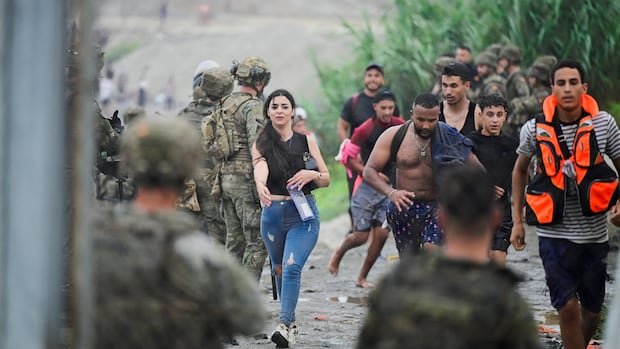

Spain and Morocco have bolstered the border fence of a Spanish enclave, effectively reducing mass crossings after tens of thousands of individuals arrived by sea and land in a single day. According to officials, at least 57 individuals have lost their lives following the entry of around 60,000 people into Ceuta in recent days. By 6 p.m. local time on Friday, an estimated 48,300 migrants had voluntarily returned to Morocco, as reported by Spain’s Interior Ministry.
The sudden influx of migrants into Ceuta, a small Spanish territory protruding into the Mediterranean from Morocco, has caused alarm and discord in Europe. France announced heightened border checks with Spain, while Italy threatened to suspend Spain from the European Union’s internal open border scheme. Moroccan authorities at the gates of Ceuta utilized water cannon trucks, batons, and tear gas to push back and prevent more individuals from storming across the border, resulting in clashes and damage to property.
Spanish authorities are aiming to swiftly deport those who entered unlawfully, despite a court ruling imposing limitations on special “border rejection” regulations allowing immediate expulsions from the enclave. Prime Minister Pedro Sanchez criticized the mass crossings as a violation of Spain’s territorial sovereignty and urged Morocco to intensify efforts to curb the outflow of people.
Ceuta and Melilla, another Spanish autonomous city in northern Morocco, represent the European Union’s sole land borders with Africa. These cities, each housing around 85,000 residents, periodically witness spikes in attempted migrant crossings to reach Europe, with Thursday’s surge being unprecedented in scale. Territorial Policy Minister Angel Victor Torres suggested that a ruling by Spain’s Supreme Court earlier this month, preventing summarily returning migrants intercepted at sea while attempting to reach Ceuta or Melilla, could have contributed to the recent surge.
Migrants often swim from the Moroccan towns of Fnideq or Belyounech to reach Ceuta, with the Moroccan side witnessing streams of migrants attempting to cross despite heightened security measures. While the direct crossing seemed obstructed, groups sought alternative routes around the fence, some even preparing to swim. The lack of adequate police presence during the surge on Thursday, as highlighted by Spain’s Guardia Civil police association AUGC, hindered timely intervention to prevent the mass influx.
Migration remains a contentious issue in Europe, especially with the rise of right-wing parties since the 2015 crisis when over a million individuals traversed the continent seeking asylum, primarily fleeing conflict in Syria. Various European countries have announced measures to bolster border security in response to the recent events in Ceuta, with concerns about potential escalations in migrant flows.
Despite differing opinions on immigration policies, Spain’s government emphasizes the positive economic contributions of immigrants, supported by extensive data. The recent offer of a mass amnesty program, leading to hundreds of thousands of individuals seeking citizenship, underscores Spain’s stance on integrating immigrants into society. Italy’s criticism of Spain’s citizenship grant to irregular immigrants was met with a firm response from Spanish authorities, stressing the need for solidarity over political posturing in addressing migration challenges.