


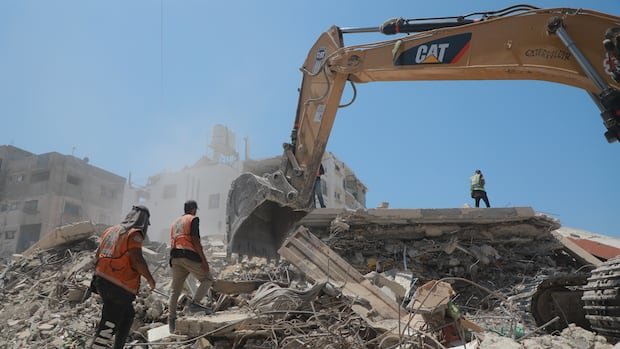

In the heart of Gaza City, members of the Al-Drimli family are engaged in a painstaking search for the remains of a neighbor who was sheltering with them when an airstrike demolished their residence in November 2023. Equipped with only shovels, buckets, a wheelbarrow, and their bare hands, they toil under the scorching midday sun. The clanging of shovels against rubble and the whirring of an electric saw create a somber symphony in the air.
Having already recovered the remains of their own loved ones at the site, the Al-Drimli family now focuses on finding their missing neighbor. According to the Gaza Health Ministry, an estimated 8,000 to 10,000 bodies still lie buried under the debris nearly three years after the conflict between Israel and Hamas began.
Ayman Al-Drimli, speaking to CBC News freelance videographer Mohamed El Saife, highlighted the challenges faced by many Palestinians in Gaza due to the scarcity and high cost of excavators. He emphasized the unavailability of expensive equipment, forcing them to rely on manual labor.
Officials and heavy equipment operators in Gaza reveal that there are only about a dozen barely operational excavators in the region. Samir Sabra, who operates two of these excavators with his son Uday, expressed the financial strain of maintaining the machines, citing the exorbitant cost of oil required for their operation.
Uday Sabra, working tirelessly at a different site in Gaza City alongside the Palestinian Civil Defence, emphasized the overwhelming demand for their services and the insufficient equipment available to tackle the extensive cleanup and recovery efforts. The dire shortage of machinery hampers their ability to expedite the retrieval of remains from the rubble.
Mahmoud Basal, spokesperson for the Palestinian Civil Defence, attributed the scarcity of excavators to the deliberate targeting of heavy machinery during the conflict. Despite a ceasefire agreement last October promising increased access to heavy equipment, the situation on the ground remains unchanged, prolonging the arduous process of recovering bodies trapped under the debris.
Border restrictions imposed by Israel on crucial supplies like fuel, oil, and spare parts further impede the maintenance and operation of essential machinery in Gaza. Humanitarian organizations and the United Nations have called for urgent action to facilitate the entry of heavy equipment into the region to accelerate the recovery and cleanup efforts.
Uday Sabra, unwavering in his commitment to the solemn task at hand, vows to persist until every lost soul is laid to rest, even as the challenges of limited equipment and resources continue to test the resolve of those engaged in the grim aftermath of conflict.