


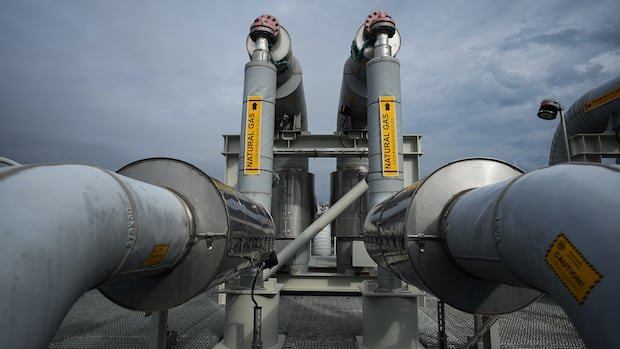

Prime Minister Mark Carney asserts that Canadian natural gas exports are vital for fueling American growth, emphasizing the significance of these exports in a recent speech. His statements raise the question of the potential consequences if Canada were to cease sending shipments to the United States.
Despite the ongoing Canada-U.S. trade tensions, energy products like oil and natural gas have not been utilized as bargaining tools. This approach has sparked debate, with Alberta Premier Danielle Smith consistently opposing the idea while Ontario’s Doug Ford advocates for exploring all available options.
In his remarks following the breakdown of trade talks between Canada and the U.S., Carney highlighted the substantial role Canada plays in supplying energy to the U.S. He noted that Canada supplies 99% of the U.S.’s natural gas imports, 85% of electricity imports, and 60% of crude oil imports.
The reliance on imports, particularly natural gas, is significant, with the U.S. depending heavily on Canadian supplies. Although the U.S. Energy Information Administration reports that Canadian gas imports accounted for nearly all of America’s non-domestic supply, it represents only a fraction of total U.S. natural gas consumption, around 8%.
Dulles Wang, director of Americas gas and LNG at Wood Mackenzie, suggests that Canadian natural gas exports to the U.S. are relatively small compared to domestic production, but the geographical distribution of these deliveries is crucial. While Texas produces more gas than it consumes, regions like the Pacific Northwest heavily rely on Canadian gas imports.
Ceasing natural gas shipments to the U.S. would have adverse effects on Canada’s industry, leading to a surplus of supply, plummeting prices, and strained storage capacities. Wang warns that such a move would be detrimental to Canada’s economic interests, emphasizing the importance of diversifying energy export markets beyond the U.S.
The Canadian government is actively pursuing non-U.S. markets, with initiatives like the LNG Canada facility in Kitimat, B.C., which started exporting liquefied natural gas to Asian markets. Efforts are underway to support projects aimed at expanding energy exports and reducing dependency on the U.S. market.
Overall, the potential disruption in Canadian natural gas exports to the U.S. underscores the complex interdependence between the two countries in the energy sector, with implications for both economic stability and strategic energy planning.