


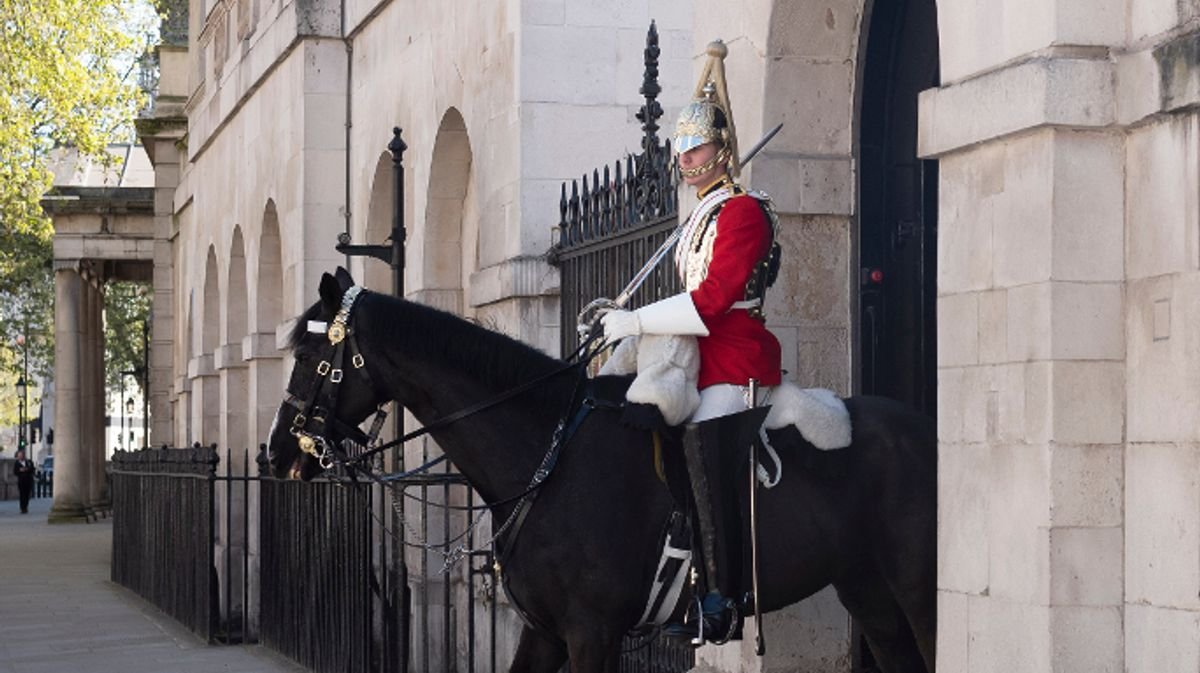

A King’s Guard member had to activate an emergency alarm when his horse nearly collapsed due to the extreme heat. The dedicated officer showed concern for his horse, which was struggling in the scorching 30-degree weather in London. Spectators observed as the Guard quickly signaled for help, leading to another service member relieving the horse at Whitehall.
An onlooker captured the moment when the guardsman, clad in a vivid scarlet wool tunic and dark trousers, awaited assistance with his horse. Following a brief pause for a tourist to snap a photo with the horse, a fellow soldier emerged to provide aid. After addressing the emergency, the soldier guided the horse and rider to a shaded area outside the Household Cavalry Museum.
As the horse’s stability wavered in the heat, it was led away behind the gates, leaving many viewers alarmed by the situation. Concerned comments highlighted the unsuitability of the conditions for both the horse and the guard. This incident occurred shortly after a previous occurrence where another King’s Guard horse had exhibited erratic behavior during a heatwave in late May.
During the May bank holiday weekend, a horse agitated by the heat caused a stir near Horse Guards Parade. In a departure from protocol, a guard intervened to calm the distressed animal before it was safely removed from the hot environment. Rising temperatures in late June also disrupted the traditional Changing of the Guard ceremonies at Buckingham Palace and Windsor Castle, leading to several cancellations.
The cancellation of these daily ceremonies, where soldiers in distinctive uniforms parade with horses to the accompaniment of a military band, was deemed necessary to safeguard the well-being of participants and spectators. The Army In London, responsible for the events, expressed regret over the cancellations and urged visitors to heed safety advice during hot weather.
Since 1660, the Household Troops have protected the Sovereign, a duty that has extended to guarding Buckingham Palace since Queen Victoria’s reign in 1837.