


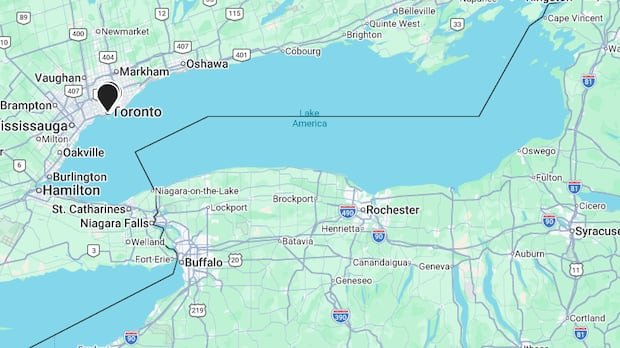

Some Canadian websites, including those for the federal government, were observed showing maps with Lake Ontario relabeled as Lake America on Sunday. This adjustment followed an announcement by Google Maps to comply with a directive from U.S. President Donald Trump.
Google explained in a post on its corporate website that the alteration was prompted by the official renaming of the lake in the U.S. government’s geographic names database. While Google stated that the modification was intended for U.S. users, several Ontario and Canadian websites displayed Lake America on their maps.
These sites included Hydro One’s outage map, the Liquor Control Board of Ontario (LCBO) store locator, GO Transit’s station finder, and the federal government’s housing and infrastructure map. Hydro One acknowledged the issue, attributing it to a third-party mapping service, and assured that efforts were underway to rectify the error promptly.
Metrolinx, the provincial agency overseeing GO Transit, also acknowledged the situation and confirmed that corrective actions were being taken to ensure accurate labeling of Lake Ontario on their websites. By the evening of the same day, adjustments had been made to restore the original naming on the maps.
While MapQuest opted not to alter the lake’s name, Apple did not publicly address the matter. Google later clarified that website developers embedding Google Maps could localize the map by selecting a specific region, which would display the correct place names based on the chosen location.
Tech analyst Carmi Levy explained that Canadian websites like Hydro One and LCBO likely relied on Google’s application programming interface (API) for their maps, resulting in the automatic switch to Lake America. Levy emphasized the importance of developers selecting Canada as the region to avoid such discrepancies but acknowledged that awareness and technical comfort levels might vary among users.
Google Maps continued to display Lake Ontario within Canada, even if users typed Lake America. However, a global update by Google made Lake America searchable worldwide, with the lake’s original name denoted as Lake Ontario in brackets for searches outside North America.
The incident underscored the dependency of Canada on American mapping technologies. Ontario’s Minister of Public and Business Service Delivery and Procurement, Stephen Crawford, acknowledged the issue and assured ongoing reviews to ensure accurate naming on government websites.
Ontario Premier Doug Ford criticized the name change proposal, expressing confidence that Lake Ontario’s historical name would endure. Trump’s attempt to rename the lake received pushback from various officials, with Prime Minister Mark Carney reaffirming the lake’s longstanding identity.
The escalating tensions between the U.S. and Canada, triggered by failed trade negotiations, led to retaliatory measures by both countries. Despite the trade disputes, Ford emphasized the importance of returning to constructive trade talks for mutual benefit.
Trump had previously issued a similar order to rename the Gulf of Mexico to the Gulf of America, reflecting a pattern of name changes for federal documents and services. Tech expert Levy drew parallels between the Gulf of Mexico renaming controversy and the current Lake Ontario situation, highlighting the complexities involved in implementing such changes across digital platforms.