


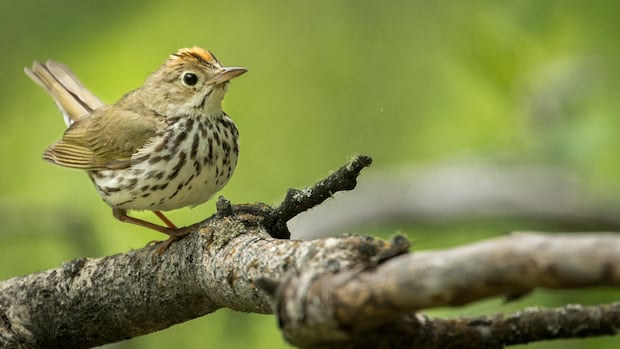

From chirps to melodies, the songs of birds can mimic the complexity of a grand orchestra.
However, ovenbirds — stout, terrestrial warblers — possess a notably restricted selection of sounds.
The male ovenbird has just one song: a quick tune often referred to as teacher-teacher-teacher.
To many, all ovenbirds may appear identical in their singing, but each one has its unique rendition.
Now, scientists are employing AI technology to monitor the well-being of ovenbird populations based solely on their characteristic songs.
Research released this month in the journal Nature Methods utilized AI to pinpoint individual ovenbirds in audio recordings obtained from Alberta and Pennsylvania.
A Singular Focus
The ovenbird’s limited song repertoire made it an excellent candidate for this study, according to lead researcher Sam Lapp, a postdoctoral researcher at the University of Colorado.
“They are quite dedicated to singing one very specific song,” Lapp remarked during an interview with CBC News.
“Many birds develop a vocal signature over their lifetimes, often incorporating various songs into what we define as a bird’s repertoire.
“In contrast, the ovenbird uniquely maintains one stable song throughout its life, singing only one variation of it.”
Ovenbirds perform their main song during springtime to establish territory and attract mates, a behavior that continues throughout their lifetimes.
Under Lapp’s guidance during his tenure with the Department of Biological Sciences at the University of Pittsburgh, the research team utilized recordings collected from nearly 130 locations in Pennsylvania over a four-year span.
They trained an AI model to identify unique song features and group similar ones together, based on the assumption that each bird would return to the same forest area every spring.
The team analyzed 9,072 hours of audio to monitor 405 individual birds, subsequently validating the model with another set of recordings obtained during the 2016 spring breeding season in Alberta’s mixed wood and boreal forests.
Lapp reported that the model could associate songs with individual birds with an accuracy rate of up to 96 percent.
This method is significantly less labor-intensive than traditional leg banding, where biologists capture birds, attach markers to their legs, and attempt to recapture them the following spring.
Lapp noted that the research idea originated from a partnership with Alberta biologists who were exploring methods to locate birds over large expanses using a network of microphones.
Astonishing Discoveries
According to Lapp, human ears struggle to differentiate between individual ovenbirds in real time due to the swift nature of their vocal differences.
However, using spectrographs — graphical representations of sound — each bird’s unique song becomes clearer, he explained.
“I began to wonder if we could teach a machine to recognize these patterns and perform automated individual recognition given that my eyes can identify them,” he said.
“Even for those who are passionate about birds and species identification, it is astonishing and somewhat magical that such intricate information exists, which we’ve overlooked… but is there if you’re attentive enough.”
Erin Bayne, a biology professor at the University of Alberta and co-author of the study, has been observing ovenbirds for many years and understands the challenges of annual population assessments.
During his PhD studies, Bayne dedicated countless hours to monitoring banded birds, eventually recognizing individuals by their unique vocal differences.
“What one bird is expressing over there differs slightly from what another is saying,” he noted. “I could identify who was who.
“They’re remarkably courteous when they sing. It’s rather amusing. One bird will sing, then wait for the other to finish, and will immediately sing right after.”
Birds Communicate in Harmony
Bayne emphasized that the research indicates avian communication is far more intricate than many people realize, suggesting that conversations occur even if we lack understanding of the language.
Just as humans exhibit distinct speech patterns, biologists are discovering that various animals also cultivate their own unique voices, Bayne explained.
“It’s not surprising that individual birds or animals exhibit detectable differences. The more we investigate, the clearer it will become that this is indeed the case.”
While there are limitations to the model, the researchers hope it offers a less intrusive means to assess the health of songbird populations simply by listening.
The AI system is ineffective in accurately monitoring the variable calls of female ovenbirds or the basic vocal sounds produced by young birds.
Additionally, the current model would not be suitable for tracking species like magpies and mockingbirds that continuously imitate new sounds or perform numerous different songs.
It is most effective for birds that maintain a consistent song throughout their lives — approximately 30 percent of songbird species — as well as certain bat and owl species.
The research team has made the program’s code available on open-source platforms to assist other biologists in monitoring the survival of various songbird populations or even other species.
Richard Hedley, a statistical ecologist at the Alberta Biodiversity Monitoring Institute who was not part of the study, remarked on its remarkable potential.
While AI acoustic monitoring has been utilized for years to track birds at the species level, demonstrating its ability to differentiate individual birds is an impressive accomplishment, he added.
There exists a vast collection of acoustic recordings that could be utilized in innovative ways, he stated.
“Catching a single bird can take many hours. Therefore, the prospect of achieving this by simply placing a microphone in the bird’s territory is incredibly promising.”