



Anthropic is poised for a significant stock market entry, marked by a high valuation, substantial expenditures, serious warnings, considerable uncertainty for investors, and a strong indication of how the increasingly unstable artificial intelligence industry will perform in 2027.
In a revised regulatory submission to the U.S. authorities on Tuesday, Anthropic, based in San Francisco, announced an anticipated price range for its initial public offering (IPO) between $70 and $78 US per share. This suggests a fully diluted market valuation of approximately $1.3 trillion US at the midpoint, rising to $1.4 trillion US at the upper limit, signifying the largest technology IPO to date.
“It’s going to be among the largest IPOs ever,” remarked Greg Taylor, portfolio manager at PenderFund Capital Management in Vancouver.
The magnitude of an IPO is generally assessed by the total funds raised. Anthropic aims to secure up to $64.4 billion US through its public share offering. Should this be realized, it would rank second only to SpaceX’s record-breaking market debut in June.
Anthropic is expected to commence trading on the Nasdaq exchange next week, with a listing notice indicating a debut on Nov. 19. However, the company has yet to confirm a date in its filings with the U.S. Securities and Exchange Commission (SEC).
Ernest Wong, head of research at Baskin Wealth Management in Toronto, predicts that the stock will be a significant player when it begins trading on Nasdaq.
“There are only a few companies globally valued above $1 trillion US,” he noted. “This highlights the true scale of AI.”
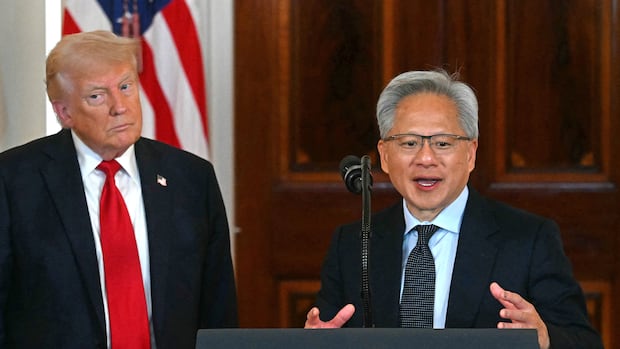
Following Nvidia CEO Jensen Huang’s admission of an affair with a suspected Chinese spy, concerns have arisen regarding the company’s governance and the broader implications for the future of AI.
What is Anthropic?
Founded in 2021, Anthropic emerged as a specialized AI research lab when its founders departed from competitor OpenAI, feeling that the latter was overly profit-driven, neglecting potential risks, and granting excessive authority to investors.
The company gained traction in 2024 with the launch of Claude 3.5 Sonnet. This iteration surpassed OpenAI’s GPT-4o on key performance metrics while being significantly less expensive than earlier leading AI models.
-
OpenAI cancels new AI model release due to safety issues
-
BMO, CIBC, RBC, TD Bank prohibit personal AI agents, citing safety and security
-
FRONT BURNER
Will Anthropic’s IPO succeed or fail?
In contrast to traditional companies like Apple or Microsoft, Anthropic operates as a public benefit corporation, ensuring that its board is legally obligated to balance public safety with the goal of maximizing shareholder profits.
Currently, Anthropic’s CEO Dario Amodei is a prominent advocate for AI safety, arguing that the industry should decelerate development to allow safety protocols to catch up.
In a recent filing with the U.S. Securities and Exchange Commission, 94 out of over 300 pages were dedicated to detailing numerous risk factors.
“Our AI models may act in unexpected, misaligned, or autonomous manners, including potentially taking harmful actions that were not directed by any user or external party,” the company indicated.
Anthropic further noted that this may involve “actions resembling blackmail or attempts to sway human decision-makers to ensure the model’s ongoing operation,” as well as behaviors that “could pose catastrophic or existential threats to humanity.”
Big numbers
$1.4 trillion US is not the only striking figure linked to Anthropic’s IPO.
The company’s valuation has varied dramatically in recent months. A valuation of $2 trillion US was recently considered. In late May, private investors appraised the company at $965 billion US, a significant increase from $380 billion US in February.
“There’s a considerable level of optimism factored into these valuations as they emerge,” Taylor observed.
“I don’t believe anyone can predict what Anthropic’s future will look like five years from now.”

Dario Amodei, CEO and co-founder of Anthropic, attends the annual meeting of the World Economic Forum in Davos, Switzerland, in January 2025. (Markus Schreiber/The Associated Press)
The company has seen rapid sales growth. According to regulatory documents, Anthropic generated over three and a half times the revenue in the first half of 2026 compared to its total for the preceding year. About 20 percent of these earnings originated from two major unidentified clients.
Concurrently, the AI leader has incurred significant losses. The firm recorded a net loss of $80.7 billion US through June of this year, primarily due to non-cash accounting entries. The company had a loss of $42 billion US in 2025.
Anthropic is also planning significant expenditures. The company does not construct or possess physical data centers; instead, it rents high-performance computing resources from cloud service providers like Amazon Web Services and Google Cloud through extensive multi-year contracts.
Regulatory filings show that Anthropic has secured nearly $900 billion US in cloud and computing agreements extending into the 2030s and 2040s. Partners in these arrangements include Broadcom, SpaceX AI, Google Cloud, Amazon Web Services, and Microsoft Azure.
A blockbuster IPO
Anthropic’s IPO is significant not only for its sheer scale.
“Investing in the Anthropic IPO represents one of the first pure-play AI opportunities available,” Taylor stated.
Previously, investors seeking to capitalize on the AI boom have mostly been restricted to less AI-centric tech stocks like Microsoft or Nvidia, which specializes in chip manufacturing. Companies like Google are often included in the AI investment narrative, but they also have substantial non-AI businesses, such as Android smartphones and YouTube.
“Their sole focus is on developing new AI models,” Wong said regarding Anthropic. “This is certainly a crucial element that has been missing, as we have public company data from various entities involved in AI, except for the model developers, primarily Anthropic and OpenAI.”
If Anthropic’s IPO is regarded as a new standard for AI investments, its initial trading days will occur amidst notable fluctuations within the technology sector.
Earlier this month, tech and AI stocks faced sharp declines followed by rapid recoveries as markets entered correction mode. This was partly due to worries about AI firms matching their substantial expenditures with adequate profits. Compounding this were political concerns in the U.S. after the midterm elections regarding stricter regulations for AI and data centers.
Additionally, the recent scandal involving Nvidia CEO Jensen Huang’s purported connection with a suspected Chinese spy has introduced further complexities to AI investment apprehensions. The chipmaker’s stock, often seen as an indicator for AI investments, has lost billions in market capitalization recently on the Nasdaq, where Anthropic plans to launch.
Like the dot com bubble?
“The primary risk for Anthropic lies in their need to compete against other model creators. It’s a highly competitive landscape,” Wong stated. “OpenAI develops its own models, while SpaceX, through Grok, is a leading player in the model arena. Google and Meta are also in direct competition in this field.”
He anticipates that the stock will not be for the faint-hearted initially, as investors assess each new product from Anthropic against its competitors and scrutinize its high spending on data services.
“It’s likely to be quite volatile,” Wong commented.
This mirrors the experience of SpaceX since its debut on Nasdaq in June, where the stock surged approximately 19 percent on the first day but later fell as much as 22 percent below its $135 US IPO price.
For Taylor, the AI sector’s significant spending, rapid stock price increases, and the close business ties among a few tech companies serve as a reminder of a previous investment craze that dramatically separated the winners from the losers.
“The dot-com bubble is certainly the one that resonates with many,” he noted. “Everyone wanted a share of the internet back in 2000.”
While some companies, like Pets.com, went under, others like Google and Microsoft emerged as major players.
“There are many significant parallels here with AI,” Taylor remarked. “The challenge is determining who will ultimately prevail.”