


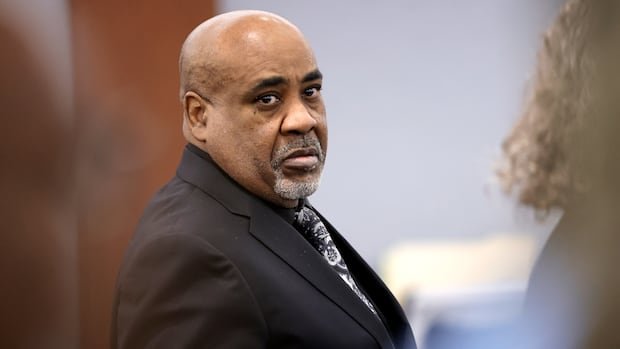

A jury has rendered a guilty verdict against Duane “Keffe D” Davis for masterminding the 1996 assassination of rap legend Tupac Shakur, marking the first conviction in a case that has captivated hip-hop enthusiasts for decades. Davis, aged 63, was found guilty on Monday of murder with the use of a deadly weapon and faces a potential life sentence. The jury reached their decision after three hours of deliberation following a lengthy trial in Las Vegas.
Upon hearing the verdict, Shakur’s sister, Sekyiwa “Set” Shakur, became emotional and reached out to someone behind her. Davis’s son was also present in the courtroom, covering his face with one hand.
During closing arguments, Chief Deputy District Attorney Binu Palal told jurors that Davis armed himself and pursued Shakur and Death Row Records co-founder Marion “Suge” Knight after they assaulted Davis’s nephew earlier that evening. Palal acknowledged inconsistencies in Davis’s recounting of the events over the years but asserted that the key detail remained constant: Davis consistently placed himself inside a white Cadillac from which the fatal shots were fired.
Defense attorney Michael Sanft challenged jurors to find evidence beyond Davis’s statements placing him in Las Vegas or inside the Cadillac on the night of the shooting. Sanft highlighted the absence of surveillance footage, phone records, and other proof linking Davis to the scene.
The long-standing case has garnered interest from hip-hop fans and crime analysts alike. Shakur, a highly influential rapper, was in Las Vegas on September 7, 1996, when he was fatally shot while stopped at a red light by a white Cadillac. Davis emerged as a key figure in the case after publicly stating that he was present in the Cadillac and supplied the gun used in the shooting as retribution for an earlier altercation between Shakur’s entourage and Davis’s nephew.
Under Nevada law, aiding in a murder can lead to a conviction for the crime. Davis is the only surviving member among the four individuals reportedly in the Cadillac that night. Prosecutors argued that Davis’s role in providing the weapon and orchestrating the attack made him legally accountable, even if he did not physically pull the trigger.
Prosecutors also contended that the shooting was premeditated, citing testimony and Davis’s accounts of actively seeking out Shakur before the attack. Palal highlighted Davis’s 2019 memoir, “Compton Street Legend,” as supporting evidence, dismissing claims that Davis altered details for profit and emphasizing the consistency of the central narrative.
In a rebuttal, prosecutor Marc DiGiacomo pointed to a scrapbook maintained by Davis containing articles about Shakur, suggesting a morbid fixation on the murder.
The trial has reignited discussions surrounding the tragic events of that night in 1996, shedding new light on a case that has remained unsolved for years.