


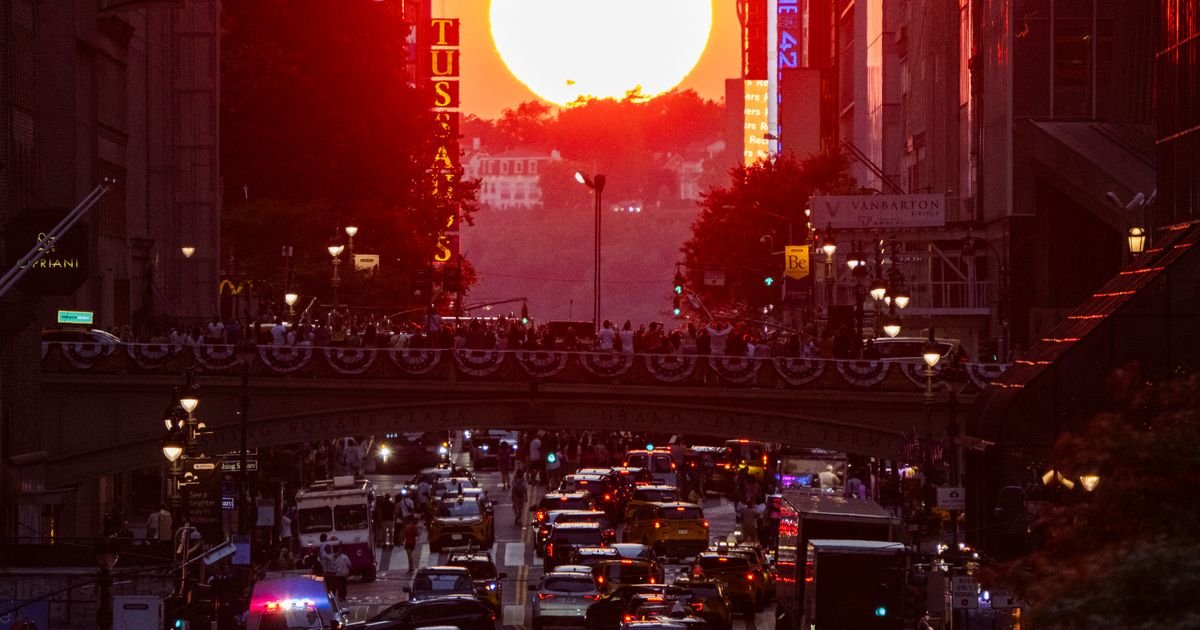

Crowds of New Yorkers and tourists gathered on the city streets to witness the breathtaking sunset align perfectly amidst Manhattan’s towering skyscrapers. Stunning images captured the radiant orange sun framed by the iconic grid of buildings, as hundreds stopped to photograph and record the rare occurrence known as Manhattanhenge. This event, occurring four times a year, showcases the setting sun aligning with the east-west streets of the borough due to Manhattan’s unique street layout angle.
Named after England’s Stonehenge by astrophysicist Neil deGrasse Tyson, Manhattanhenge made its final summer appearance on July 12. This event marked the culmination of a series of dramatic sunsets across the city before the seasonal display concluded. In the upcoming month, New Yorkers can anticipate another celestial event as a partial solar eclipse will be visible on August 12.
The setting sun, seen glowing amidst Manhattan’s towering skyscrapers, heralded the return of Manhattanhenge for its last summer showcase. This rare phenomenon attracted crowds across New York, with the massive orange sun perfectly framed by the city’s east-west streets.
Manhattanhenge occurs due to the borough’s street grid being angled about 30 degrees east of true north, aligning the sunset with the streets only on four evenings annually. This astronomical marvel, coined by Neil deGrasse Tyson after England’s Stonehenge, occurred on July 12 and marked the final full sunset alignment of the summer.
Numerous individuals paused to witness the spectacular sunset unfold, with many capturing the fleeting moment on their phones. Tourists and locals lined the streets to witness the sun sinking amidst the city’s skyline, creating one of New York’s most photographed natural phenomena. Manhattanhenge has become an annual tradition, attracting photographers, social media influencers, and astronomy enthusiasts eager to capture the perfect shot before the sun dipped below the horizon.
Despite occurring near the summer solstice, Manhattanhenge did not coincide with the longest day of the year. The event took place due to Manhattan’s rotated street grid rather than a precise north-south orientation. This alignment occurs four times annually, twice before and after the summer solstice.
While Manhattanhenge is commonly associated with four sunset alignments yearly, the visual impact extends beyond these dates. The “Manhattanhenge Effect” spans several weeks as sunsets gradually align and shift out of sync with the city’s famous grid. This year’s summer phenomenon began before July and concluded with the final alignment on Sunday, providing photographers with ample opportunities to capture stunning images of sunlight streaming between skyscrapers.
Following Manhattanhenge, skywatchers can anticipate another celestial event. On August 12, a partial solar eclipse will be visible in New York, with the moon covering approximately 10% of the sun’s surface. Although the eclipse will be visible across North America and Europe, the most dramatic views are expected along a narrow path crossing Greenland, Iceland, and Spain, where a total solar eclipse will occur. Eclipse glasses will be necessary throughout the event in New York as the sun will never be fully obscured.
For those who missed the summer spectacle, another opportunity awaits later in the year with the return of Reverse Manhattanhenge. Unlike the traditional event focusing on dramatic sunsets, the winter edition will feature the rising sun shining through Manhattan’s streets at dawn, offering viewers another chance to capture the city’s skyline bathed in golden light.