


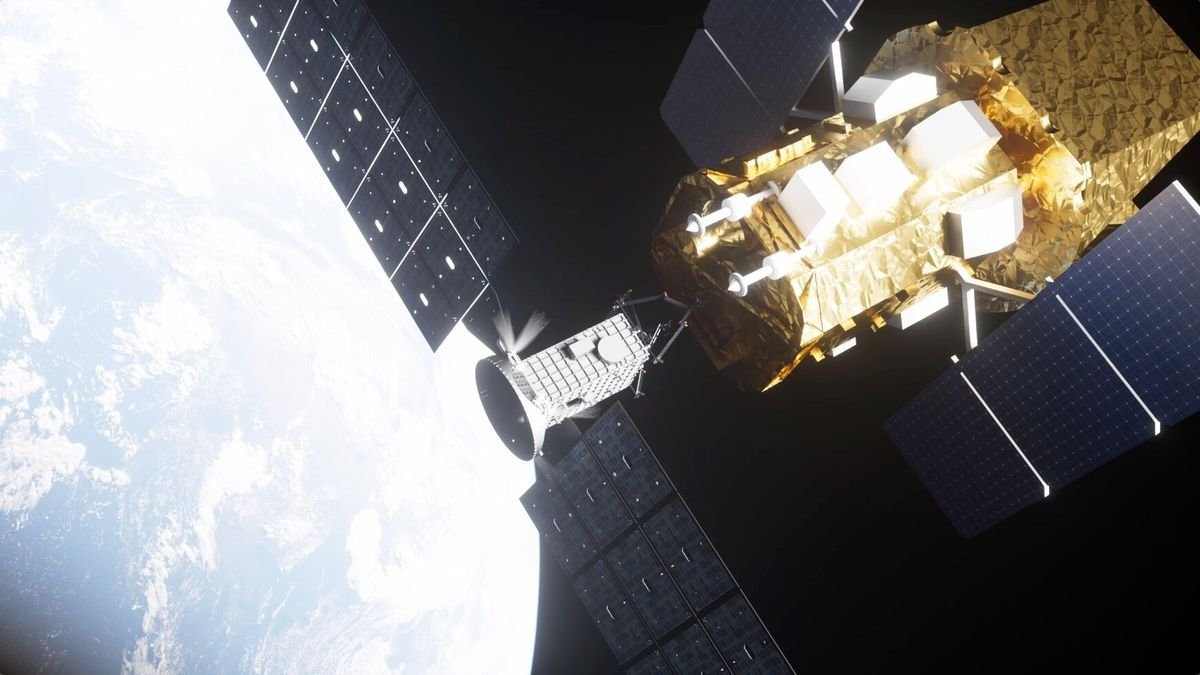

NASA has undertaken a bold mission to intercept a plummeting telescope in space. The Swift observatory faces destruction upon re-entering Earth’s atmosphere, prompting the unprecedented effort to retrieve it and return it to a safe orbit 373 miles above.
Swift holds a unique capability to detect powerful cosmic explosions from the early universe. The retrieval operation involves a spacecraft robot, the size of a fridge, equipped with small thrusters to perform the delicate grab-and-drag maneuver without causing harm to Swift.
The success of the three-armed spacecraft’s launch on Friday to capture Swift could lead to the potential rescue of other critical satellites like the renowned Hubble Space Telescope, potentially saving considerable costs.
NASA enlisted private company Katalyst Space Technologies to construct the spacecraft and execute the intricate mission. The company’s CEO, Ghonhee Lee, emphasized the high stakes involved, highlighting the risk of losing Swift to atmospheric incineration if no action was taken.
Recent heightened solar activity has affected Swift, causing its gradual descent and endangering its impending destruction in October. Launch challenges due to adverse weather and technical issues delayed the deployment of the Link spacecraft, which finally took off from the Marshall Islands using a Pegasus rocket.
Experts, including Dr. Simeon Barber from the Open University, expressed optimism about the mission’s significance in enabling the study of high-energy phenomena facilitated by Swift’s advanced telescopic capabilities.
Originally launched in 2004 at a cost of £220 million, Swift’s rescue mission has incurred a £22 million expense for NASA. The plan involves slowly raising Swift’s orbit to stabilize it for an extended period, ensuring its continued scientific contributions.
The successful recovery of Swift could pave the way for future satellite rescue missions, potentially including the large-scale Hubble Space Telescope. This innovative approach could revolutionize satellite maintenance, extending their operational lifespans at a fraction of the cost of new missions.
Katalyst Space Technologies’ Vice President of Technology, Kieran Wilson, anticipates that the Swift Boost mission will redefine astronomers’ perspectives on satellite longevity and maintenance practices.