


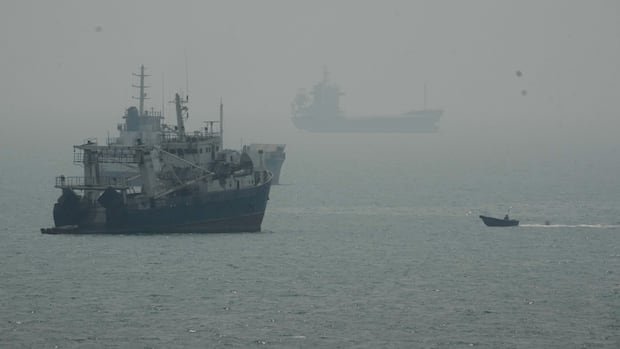

Iran announced on Wednesday that it had launched attacks on 10 ships near the Strait of Hormuz in response to the sinking of five Iranian oil tankers by the United States. This exchange marked the most significant series of retaliatory strikes on shipping by both parties since the commencement of the six-month-long conflict.
The Islamic Revolutionary Guard Corps (IRGC) of Iran reported carrying out a ballistic missile assault on a U.S. forces base near Al Azraq, located in eastern Jordan. Additionally, they targeted two U.S. vessels and eight oil tankers that were trying to navigate through a designated off-limits area within the Strait of Hormuz.
These incidents in the crucial maritime passage resulted in a surge in global oil prices, with the Brent crude benchmark exceeding $100 per barrel for the first time since July. The ongoing conflict, coupled with escalating hostilities between Saudi Arabia and the Iran-aligned Houthis in Yemen, has introduced further instability in energy markets.
The attacks by the Houthis on four cities in Saudi Arabia, causing significant damage to oil installations, have added to the uncertainties. This situation has impacted American consumers, leading to a notable increase in gasoline prices, with a gallon of regular gasoline averaging $4.15 in the U.S., marking a 26% rise from the previous year. Diesel prices have seen a more substantial increase, with a cost of $5.90 per gallon, representing a 59% year-over-year escalation.
The prolonged conflict has raised concerns about the likelihood of a durable agreement before the U.S. midterm elections. In response to the escalating prices, the Canadian government has extended the gas tax holiday until the end of January.
The U.S. military released footage showing the destruction of five Iranian oil tankers, attributing the action to Iran’s previous targeting of a U.S. Navy warship with ballistic missiles. Tensions remain high as Iran expands its restricted maritime zone around the Strait of Hormuz and deploys advanced missiles against U.S. vessels.
Iran’s Revolutionary Guards unveiled plans for a broader restricted area encompassing parts of the Gulf of Oman and the Arabian Sea, extending from Chabahar in Iran. Meanwhile, reports emerged of a drone strike on an Iraqi oil tanker in Iraqi waters, triggering a fire onboard without causing casualties among the crew.
As the conflict disrupts shipping routes through the Strait of Hormuz, a critical global oil transit point, the situation remains volatile. Despite U.S. efforts to guide tankers through the strait, the full impact on oil flow remains challenging to assess accurately. An atmosphere of uncertainty persists as both sides continue their military actions in the region.