


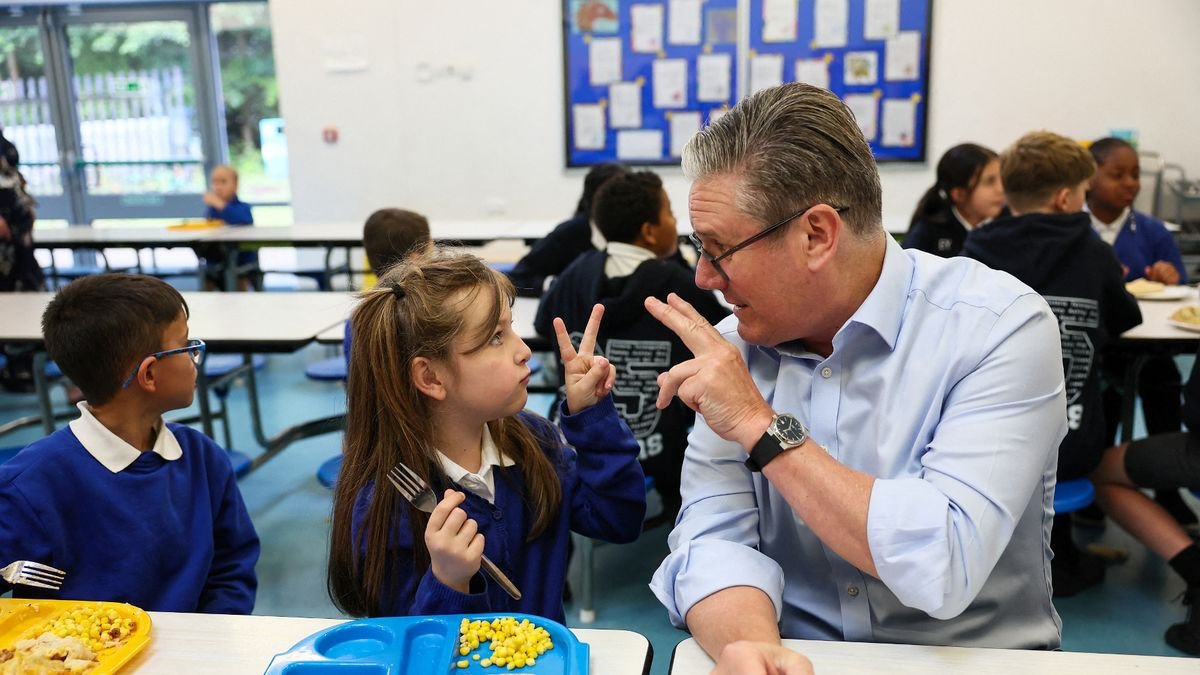

A recent survey reveals that a majority of individuals in England are in favor of extending free school meals to all primary school children. The initiative has garnered support across various political groups, including 83% of Labour supporters, 84% of left-wing party switchers, and 67% of right-wing party switchers, according to research conducted by More in Common and the National Education Union.
This growing support puts pressure on potential future Prime Minister Andy Burnham to surpass Keir Starmer’s efforts in widening access to free school meals. The current plan, announced by the Prime Minister, will make free hot lunches available to all children in families receiving universal credit starting this September, benefiting around half a million children.
The Mirror has been advocating for free school meals for all primary school children and commended Starmer’s significant expansion, which was initially introduced last summer. The survey also highlighted that parents overwhelmingly support universal free school meals, with 82% in favor. Moreover, a significant portion of individuals without children and those who consider themselves financially stable also back the policy.
The primary motivation behind supporting universal free school meals is to address child poverty, cited by 37% of respondents, followed by easing the financial burden on families (33%) and promoting equal treatment of all children (33%).
In a recent speech, Education Secretary Bridget Phillipson endorsed a “universal early years” program, emphasizing the economic and social benefits of providing more assistance to parents. Alex Newton, deputy director at More in Common, emphasized the broad public support for universal free school meals, stating that it could be a unifying policy for the incoming Prime Minister, Andy Burnham.
The Department for Education defended the government’s actions, highlighting the historic move to provide free school meals to every child from a household claiming Universal Credit. This initiative, alongside other measures like removing the two-child limit, expanding childcare, and introducing free breakfast clubs, is expected to have a significant impact on reducing child poverty.
The survey, conducted by More in Common, involved 2,011 adults in April and 2,993 adults in June in England.