


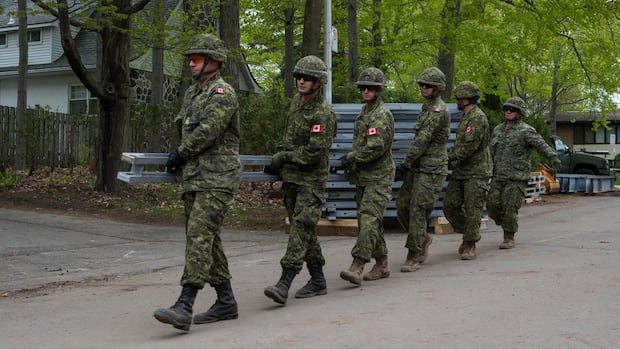

On Thursday, Canada’s Army implemented one of the most significant structural transformations in decades by moving from geographically based divisions to those organized by specific missions.
At Canadian Forces Base (CFB) Edmonton, a signing ceremony and parade marked the establishment of the 1st Canadian Division, which will be the primary force tasked with executing large-scale combat operations and addressing crises.
Based in Edmonton, the “manoeuvre division” will consolidate various capabilities, including tanks, armored vehicles, artillery, light infantry, paratroopers, and engineers, under a single command.
The goal is to enable the army to swiftly deploy a substantial force and maintain extended operations.
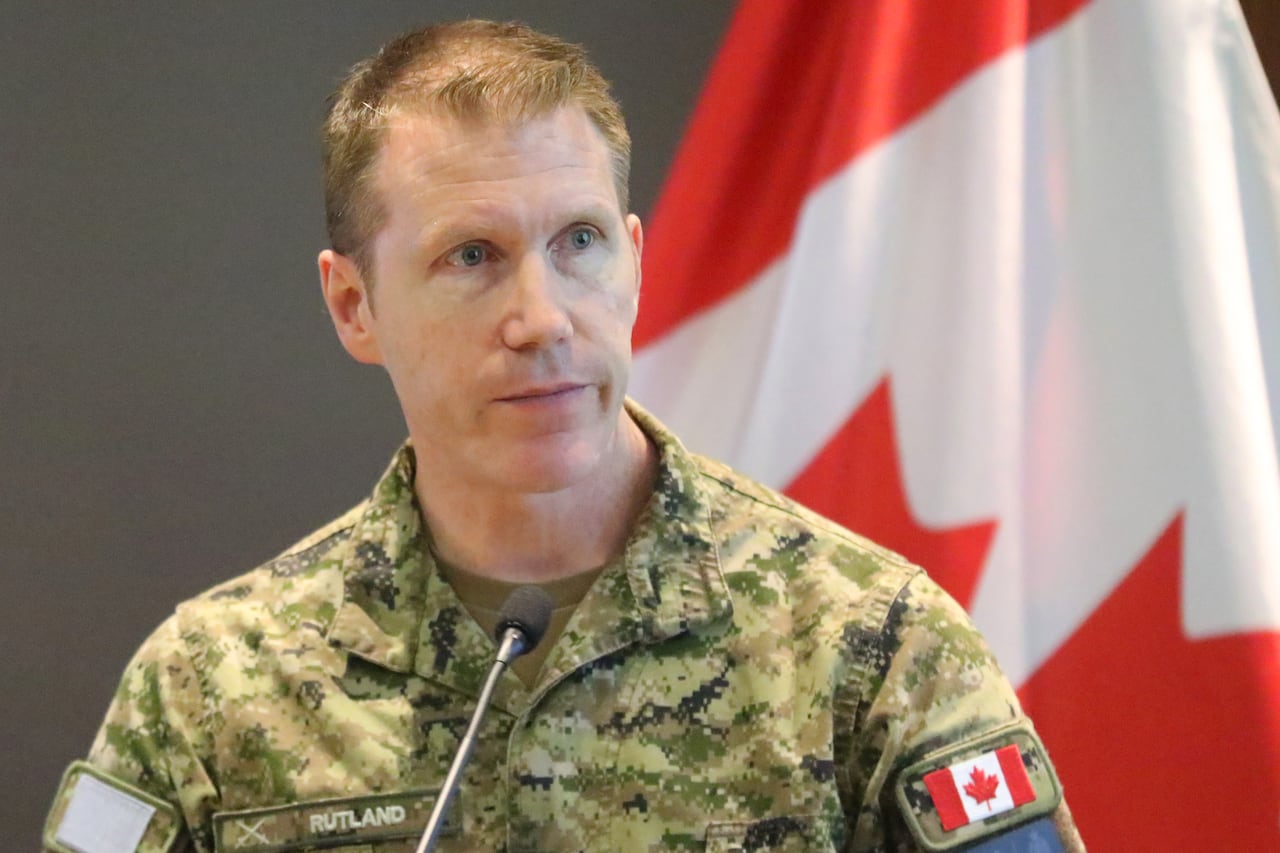
Brig.-Gen. Wade Rutland stated that the change aims to enhance the army’s responsiveness, as seen during his speech in Calgary in June 2025. (Dave Chidley/The Canadian Press)
Maj.-Gen. Wade Rutland, the head of the newly formed 1st Canadian Division, remarked in an interview, “This represents a significant shift.”
Rutland added, “This is not merely a reorganization of the existing structure. We are making these changes to enhance our agility, effectiveness, and relevance in defending Canada.”
He pointed out that the threat landscape has evolved, with the world witnessing a resurgence of large-scale combat operations involving hundreds of thousands of troops, similar to the situation in Ukraine.
“We recognized the necessity of establishing what we term a war fighting division, which will unite thousands of troops capable of integrating air, cyber, and space capabilities, thereby positioning us as a reliable ally in potential future conflicts,” he explained.
This initiative is part of a broader set of structural adjustments mandated by Lt.-Gen. Michael Wright, who outlined his vision for modernizing the army in a 2025 document titled Inflection Point.
In addition to the manoeuvre division, the army will establish a support division, which will operate from Kingston, Ontario.
Moreover, a “defence of Canada” division, known as the 2nd Canadian Division, will be created in Montreal. This division will primarily consist of part-time soldiers and will concentrate on national emergencies and domestic security.
The 3rd Canadian Division, with roots tracing back to the First World War and participation in the 1944 D-Day landings at Juno Beach, will be moved to the supplementary Order of Battle.
This transition occurs when a regiment is deactivated but remains administratively intact in case it needs to be reactivated.
The regular forces from the 3rd will be integrated into the 1st Division, while its reserves and rangers will join the 2nd Division, and its support personnel will be assigned to the support division.
Under the new structure, the 1st Canadian Division, which has a legacy dating back to 1915 and was instrumental in the capture of Vimy Ridge, will oversee three Canadian Mechanized Brigade Groups located in Edmonton, Petawawa, Ontario, and CFB Valcartier in Quebec.
Additionally, it will manage the 3rd Light Infantry Regiment, the Canadian Artillery Brigade, the 6 Canadian Combat Support Brigade, and the 1 Canadian Sustainment Brigade.
“This is significant for us,” Rutland stated. “The 1st Division was the first to engage in combat during the Second World War, making the initial landings in major operations in Italy and Sicily.”