


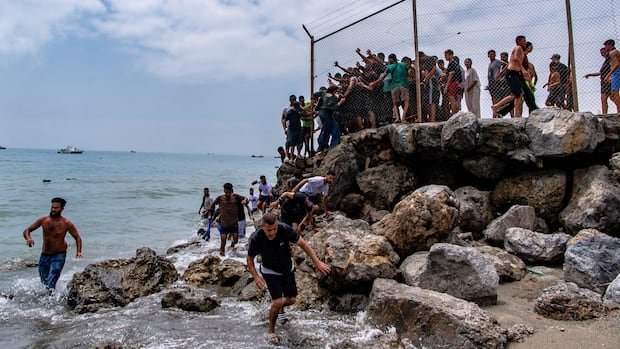

Authorities have characterized the recent events as disorderly, unsustainable, and a violation of norms. More than 50 individuals have lost their lives following the breach of the Moroccan border into Spain’s Ceuta enclave by a large number of migrants, causing alarm and discord in Europe. On Thursday, approximately 60,000 individuals entered the Spanish enclave in North Africa, with around 48,300 returning to Morocco by Friday evening. The migrants utilized various means to enter, including swimming from the Moroccan town of Fnideq, a distance of five kilometers, or attempting to cross from the nearby town of Belyounech, which is closer.
Several swimmers described the challenging journey, highlighting the risks involved. Concerns were raised about children and unaccompanied minors making the perilous journey, with a Moroccan NGO warning about the dangers faced by young migrants on irregular migration routes.
Ceuta and Melilla, both autonomous cities belonging to Spain, are vital points of access for migrants seeking economic improvement or refuge from violence in their home countries. These territories are heavily fortified and represent a gateway for individuals attempting to reach Spain from Morocco and other parts of Africa. The recent surge in migrants has been attributed to various factors, including a recent legal decision by the Spanish Supreme Court affecting sea arrivals and alleged involvement of human smugglers. The events have exposed underlying social issues in Morocco, such as limited opportunities for young people and economic hardships, prompting many to seek better prospects across the border.
In response to the influx, Spain deployed military forces and additional police to manage the situation. Efforts were made to expel illegal entrants swiftly, while on the Moroccan side, security forces resorted to using force to prevent further crossings. The chaos led to migrants returning to Morocco, citing difficulties in finding shelter and sustenance in Ceuta. Despite the challenges, some migrants continued their attempts to enter the enclave by alternative means.
The sudden surge of migrants and the subsequent developments have underscored the complex dynamics at play in the region, with political and social factors contributing to the crisis. The events in Ceuta serve as a critical test for the power dynamics in the Mediterranean region, highlighting the need for coordinated efforts to address the root causes of migration and ensure the safety and well-being of those involved.