


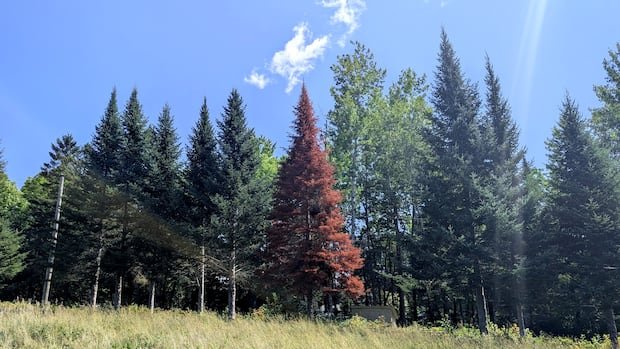

Balsam fir trees in New Brunswick are undergoing a concerning transformation, as they are turning red and perishing due to the severe drought experienced last summer. This phenomenon is causing worry about the survival of the provincial tree.
Prof. Anthony Taylor, a forestry researcher at the University of New Brunswick, has been closely monitoring the situation. He has been in contact with woodlot owners who have reported the damage, and he has witnessed the distressing sight of the once vibrant evergreen trees, commonly used as Christmas trees, slowly changing color, drying out, and ultimately dying.
Taylor noted that the current pattern aligns with his observations from past hot and dry summers. He emphasized that the warm and dry conditions, such as the drought of the previous year, have a detrimental effect on the growth capacity of balsam fir trees.
Having studied the impact of climate change on New Brunswick’s forests for an extended period, Taylor highlighted that similar instances of balsam fir die-offs occurred after unusually hot and dry summers in 1986 and 2018. He explained that during drought conditions, the trees halt the photosynthesis process prematurely, hindering their growth and energy production required for essential metabolic functions and defense mechanisms.
The shallow root system of these trees further exacerbates their struggle to access water during dry periods. Peter McKeil, a woodlot owner in Burtt’s Corner, noticed the damage on his property as early as June, with the trees progressively turning red from the lower branches upwards. He estimates a loss of approximately 100 trees so far and has adjusted his harvesting practices to salvage value from the remaining fir before more trees succumb.
Expressing concerns about the future of balsam firs in the region, McKeil believes that with the escalating impact of climate change, the species may be doomed, particularly in southern New Brunswick. He anticipates a potential northward shift for the trees as they adapt to changing environmental conditions.
Taylor emphasized the urgent need for climate action in light of the visible impact on the balsam fir trees. He likened the situation to a warning signal, indicating the repercussions of a changing climate. Taylor’s hope is that his research will prompt necessary changes in societal practices, urging a shift away from fossil fuel consumption and unsustainable forest management to address the pressing issue of climate change.