


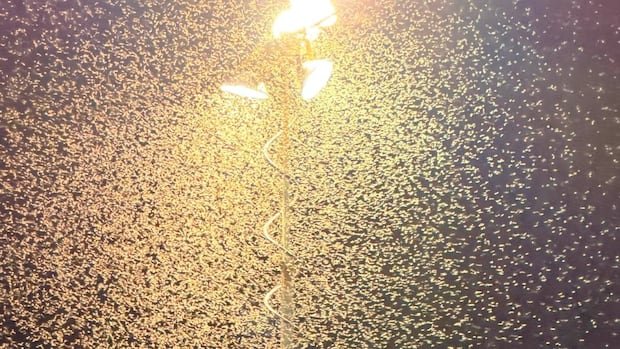

The Pasadena Days-Humber Valley Strawberry Festival in Pasadena this year featured a remarkable yet unusual concert experience as spruce budworm moths swarmed the event. Vanessa Newman, a member of the band Merrymaker from Corner Brook, described the scene as resembling a snowstorm, with moths everywhere, even landing on their instruments and in their hair. Despite the unexpected moth invasion, the crowd remained enthusiastic throughout the night.
The abundance of moths was a result of the ongoing spruce budworm outbreak in Newfoundland and Labrador. These insects, which typically live for about two weeks in their adult moth stage, have been causing devastation to the local tree population. The outbreak, long anticipated and overdue, has been escalating in recent years, posing challenges to forestry management and forest health.
Lloyd Hollett, owner of the Newfoundland Insectarium, expressed astonishment at the unprecedented scale of the infestation, extending beyond the Humber Valley. While the current moth numbers have started to decline in some areas, concerns linger about the potential impact in the following year. Natural factors, such as temperature fluctuations, play a crucial role in regulating spruce budworm populations.
The provincial government has been implementing strategies to combat the outbreak, transitioning from widespread spraying programs to targeted protection measures aimed at preserving high-value forested areas. The decision not to spray this year reflects a shift towards a more tailored approach to forest conservation in the face of persistent spruce budworm challenges.
As Newfoundland and Labrador grapples with the ongoing spruce budworm crisis, the province continues to monitor insect populations and tree health to determine future interventions. The cycle of spruce budworm outbreaks, deeply rooted in the region’s forestry history, underscores the need for adaptive and sustainable forest management practices to mitigate the impact of these destructive insects.