


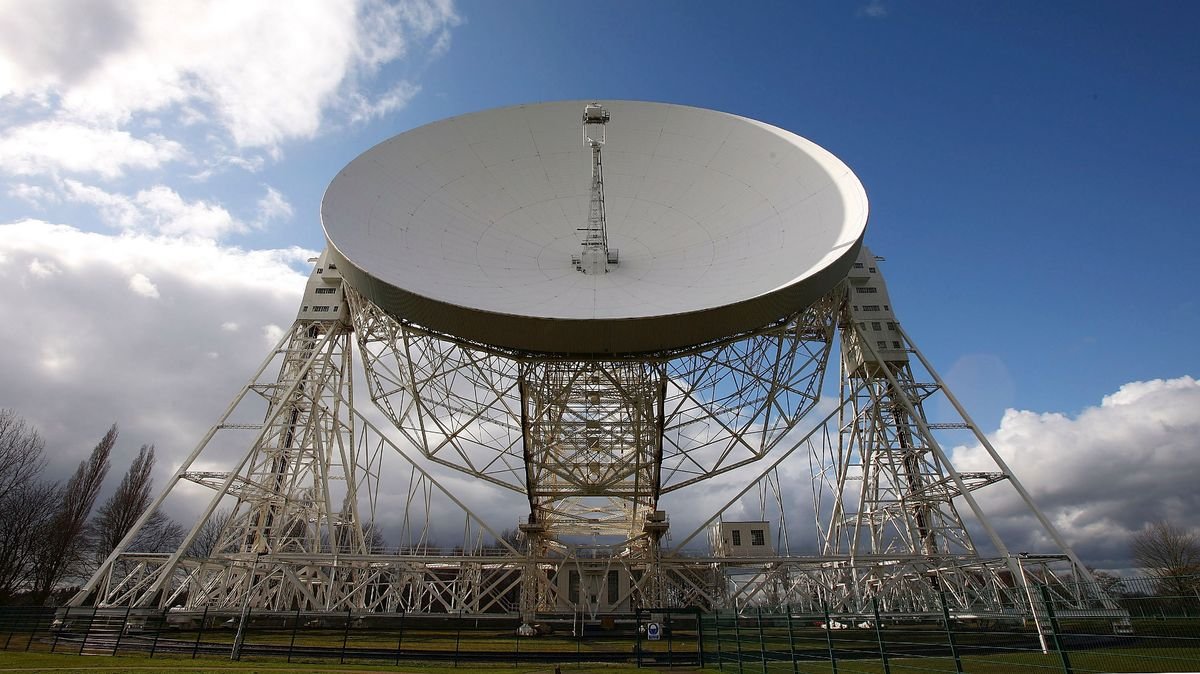

The renowned Jodrell Bank Observatory, home to the largest telescope in Britain, is facing closure as a result of reduced government funding. This decision has sparked criticism from scientists, who argue that the observatory and its network of telescopes play a crucial role in advancing scientific research. However, the UK Research and Innovation (UKRI) agency defends its choice to prioritize projects with significant long-term impacts.
Established in 1945 in Cheshire, the observatory has been instrumental in pioneering radio astronomy and exploring the universe. It served a critical function during the Cold War by monitoring Soviet missiles and contributing to the US Space Race efforts. Sue Ferns, from the Prospect trade union, emphasized the significance of Jodrell Bank as a key scientific facility that drives research capabilities and inspires future generations in science and engineering.
The Observatory is home to the renowned Lovell Telescope, the third-largest steerable radio telescope globally, alongside several smaller telescopes. Despite its rich history and scientific contributions, the observatory is set to close by April 1, 2028, unless alternative funding solutions are found, according to Prof Simon Garrington, the associate director.
The UKRI has announced a 2.7% budget cut for astronomy, nuclear, and particle physics research over the next four years, aiming to reduce its £10 billion budget. The planned termination of the £2.8 million Jodrell Bank budget has raised concerns about potential job losses and the impact on thousands of scientists. Prof Michele Dougherty, executive chair at UKRI, defended the decision as necessary for achieving financial sustainability by 2029/30.
In response to the closure threat, the Jodrell Bank leadership team intends to challenge the decision and seek alternative funding to sustain the Lovell Telescope’s operations. Jodrell Bank’s UNESCO World Heritage status in 2019 underscores its significant contributions to science, while its appearances in popular culture highlight its iconic status in the scientific community.
Paul Howarth, president of the Institute of Physics, expressed disappointment over the cuts, warning of the detrimental effects on the scientific community and the UK’s research reputation. He urged the government to reconsider these decisions to protect the country’s scientific capabilities and preserve iconic symbols like the Jodrell Bank radio telescope.