


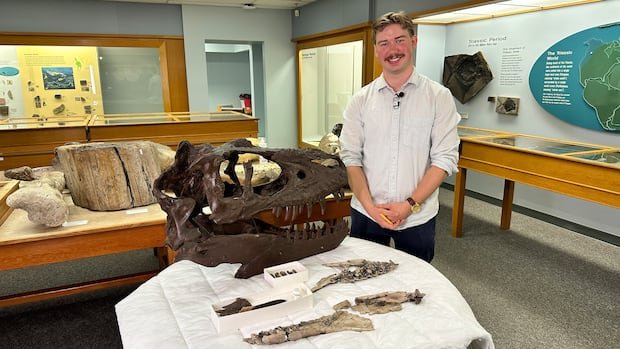

A groundbreaking finding by University of Alberta researchers suggests that a smaller raptor dinosaur might have feasted on a larger tyrannosaur, based on bite marks discovered on an Albertosaurus jaw fossil.
The fossil belonged to an eight-year-old Albertosaurus, a sub-adult, showing bite marks that prompted two possible explanations for what occurred after its death in Drumheller, Alta., approximately 130 kilometers northeast of Calgary around 70 million years ago.
The leading theory proposed by the researchers is that a raptor, a smaller carnivorous dinosaur, scavenged on the deceased Albertosaurus, which had not yet reached full maturity.
Philip Currie, a University of Alberta professor specializing in dinosaur paleobiology, emphasized the significance of this rare insight into carnivorous dinosaurs’ feeding habits, especially with Albertosaurus being a dominant predator of its era.
This finding sheds light on the dynamics of carnivorous dinosaurs’ interactions and the intricate prehistoric food chain, potentially altering our understanding of these ancient ecosystems.
The research, led by Joshua Doyon, a paleontology master’s student at the U of A, analyzed the spacing between the bite marks to conclude that a raptor was the probable culprit, although an alternative theory suggests cannibalism by a much younger Albertosaurus individual.
Unveiling a Discovery
The fossil, discovered in 2022 by a member of the public exploring the badlands north of Drumheller, led to further examination by the Royal Tyrrell Museum, revealing the tooth marks that initiated Doyon’s subsequent research project in 2023.
Doyon’s interest in dinosaur behavior and species interactions fueled his investigation into this ancient feeding event, offering a unique glimpse into a bygone era of predatory behavior.
Currie emphasized the importance of scrutinizing fossil details like tooth marks to enhance our understanding of dinosaur biology and ecological relationships within prehistoric environments.
The discovery showcases a rare instance of one carnivorous dinosaur preying on another, rather than the more common predator-prey relationships in ancient ecosystems.
The smaller raptors in Alberta, belonging to the dromaeosaur group like Atrociraptor, were significantly smaller than the cinematic portrayals seen in Jurassic Park, with Doyon encouraging closer examination of small tooth marks on dinosaur bones for potential discoveries.