


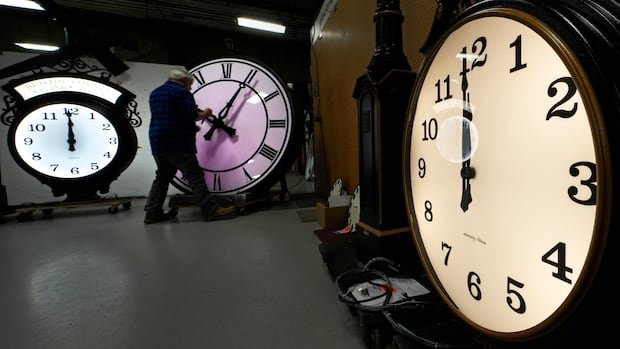

For over five decades, humanity has utilized “leap seconds” to maintain synchronization between our timepieces and the Earth’s rotation. Recently, a global timekeeping organization based in France decided to eliminate leap seconds and allow the clocks to gradually drift out of sync by up to a full hour, a process that could span centuries or even millennia.
The precise atomic time, a system introduced in the 1950s and achieved by monitoring atomic vibrations, slightly deviates from solar time, which references the sun’s position relative to a specific Earth location due to the gradual deceleration of the planet’s rotation. To rectify this discrepancy, the leap second was introduced in 1972, involving an immediate addition of ten seconds, according to Scott Beattie, the head of the frequency and time team at the National Research Council of Canada’s Metrology Research Centre.
Since then, the International Earth Rotation and Reference Systems Service has been overseeing the gap between solar and atomic time to determine the necessity of adding an extra second. Leap seconds have been inserted 27 times, with the most recent one in 2016, typically occurring at the end of December or June.
If these minor corrections were not made, noticeable changes would not occur within our lifetimes. However, in the long run, Beattie warns of a scenario where daylight might coincide with midnight and darkness with noon.
Similar to leap years, which add a day to February every four years to align the Gregorian calendar with the seasons due to Earth’s approximately 365¼-day orbit around the sun, leap seconds serve a similar purpose. Beattie emphasizes that without leap years, the calendar would eventually mismatch with the seasons, leading to hot months falling in what is now winter.
The decision to eliminate leap seconds stemmed from the increasing challenges that precise timekeeping poses to various systems like technology and telecommunications. Discrepancies in implementing leap seconds across networks raise the risk of system failures, as witnessed by incidents such as Reddit and LinkedIn crashes in 2012 and brief outages at Cloudflare in 2016.
Moreover, recent observations indicate that the Earth’s rotation has accelerated over the past six years, potentially necessitating a “negative leap second” involving time subtraction in the future. Tech giant Meta highlighted the disruptive impact such changes could have on software systems.
The International Bureau of Weights and Measures recently approved a resolution to accumulate these extra seconds until they reach 3,600, equivalent to an hour, before adjusting the clocks, a change set to take effect in May 2027. While this approach has garnered some criticism, experts acknowledge the complexities involved in maintaining precise timekeeping systems amid evolving variables affecting Earth’s rotation speed.
Samantha Lawler, an associate professor of astronomy, emphasizes the challenges in creating a flawless system to accommodate these shifts, noting the inherent imperfections in tracking time relative to celestial movements. Lawler suggests that despite these challenges, humanity must accept the inherent margin of error in timekeeping systems.