


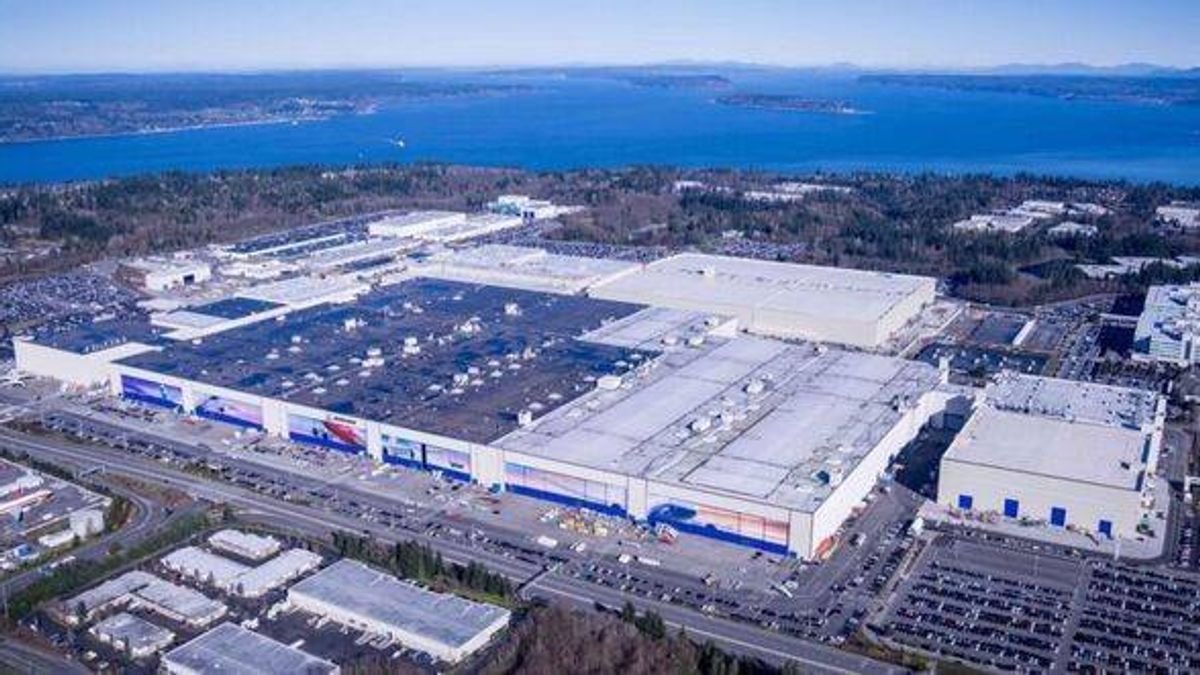

A colossal factory spanning over 472 million cubic feet holds the title as the world’s largest building and boasts its own microclimate. Situated in Everett, Washington, the expansive Boeing facility outstrips the Tesla Gigafactory by 33% and has manufactured over 5,000 wide-bodied aircraft since its inception in 1967.
This massive site occupies 98 acres, surpassing the original Disneyland resort in Anaheim, California, which covers roughly 85 acres. The idea for the plant emerged when Boeing’s then-President and Chairman William M. Allen realized the need for a new manufacturing space to construct the groundbreaking 747 aircraft, which was significantly larger than any existing passenger plane.
After considering various locations, including one in California, the company settled on a disused military airfield just 22 miles from its headquarters in Seattle. The construction of the facility, completed in just over 12 months, cost over $1 billion, exceeding Boeing’s total value at the time.
The factory’s sheer size necessitated the removal of 4 million cubic yards of earth, prompting the creation of a dedicated railway line for transporting the excavated material. The facility’s immense scale allowed Disneyland to fit comfortably inside. Originally creating its own microclimate with indoor cloud formation, the factory now relies on modern air conditioning.
The site has undergone two significant expansions, first in 1978 for the Boeing 767 and again in 1992 for the larger Boeing 777. Recent additions include structures for robotic assembly of the 777’s fuselage and manufacturing the composite wing for the latest 777X model.
In 2024, about 36,000 employees work in shifts at the sprawling site, engaging in various roles beyond aircraft production. The facility offers tours to visitors, attracting over 239,000 attendees in 2024. The tours have gained popularity, with guests like David and Georgiana King returning to witness technological advancements in aircraft construction.
Internal transportation within the facility is facilitated by a network of underground tunnels spanning over two miles, along with bicycles and vans for employee mobility. The production floor features button-operated doors and overhead cranes covering 31 miles of tracks to move aircraft at a slow pace during assembly.
The intricate aircraft painting process, lasting up to a week, consumes hundreds of liters of paint per aircraft. Boeing expects the first 777X delivery to airlines by 2027, with 619 orders placed as of November 2025.