



The first correspondence is dated March 31, 1970.
Father Leonard Joseph Kelly was instructed to leave his parish without delay. The bishop felt there was no alternative.
“It appears you have been engaging in these actions for an extended period,” the letter from John Michael O’Neill, then the bishop of Grand Falls, states. “You need to make immediate arrangements to depart from Baie Verte permanently. To prevent scandal, you can claim that you are unwell and require medical attention.”
The language used is vague. The bishop does not clarify exactly what the priest has done, merely referring to it as a “problem” that is much more “deep-seated” than previously recognized.
O’Neill urges Kelly to be candid and truthful while emphasizing the importance of confidentiality.
“I considered calling a meeting of the consultors but opted against it for fear that information might leak,” O’Neill wrote.
Rather than notify authorities, newly discovered letters reveal that the bishop referred the priest to the Southdown Institute — a contentious therapy center near Toronto, which has been treating priests for various issues, including alcoholism, depression, and pedophilia, for decades.
These letters, found in Kelly’s personnel file at the Roman Catholic Episcopal Corporation of Grand Falls, are now pivotal to an unusual legal case in central Newfoundland.
The church’s insurance provider is pursuing a Norwich order — a rare legal maneuver that compels a third party to surrender essential documents that could lead to a lawsuit against another entity.
In this instance, Guardian Insurance is requesting that a judge mandate the Southdown Institute to release its records concerning Kelly to ascertain the reasons for his admission there in 1970.
Guardian suspects that the documents could demonstrate that the church was aware of Kelly’s potential risk to children prior to entering into an insurance policy in the 1980s. These records could facilitate another legal action, in which Guardian aims to avoid covering the Roman Catholic Episcopal Corporation of Grand Falls for Kelly’s misconduct during its policy term due to material non-disclosure or misrepresentation.
I cannot be expected to condone the seriousness of his betrayal of confidence and the terrible scandal which, but for the discretion of the family involved, could have blighted the whole life of the church in this small province.Bishop John Michael O’Neill
The church is currently facing a lawsuit, initiated in 2022, accusing Kelly of sexual abuse in Gander.
The plaintiff claims he was “subjected to regular and frequent forced oral sex and occasionally other invasive sexual touching by Kelly” between 1977 and 1983, when he was aged six to twelve.
Kelly was also convicted of sexually assaulting two 12-year-old boys in the mid-1980s. A provincial court judge sentenced him to two years of probation, contingent upon his return to the Southdown Institute for treatment.
The province’s court of appeal deemed this sentence inappropriate, instead imposing a four-month jail term on Kelly in 1988.
Bishop credited family’s ‘discretion’ in avoiding scandal
The Roman Catholic Episcopal Corporation of Grand Falls is the church’s governing body overseeing larger areas such as Grand Falls-Windsor and Gander, while also managing numerous smaller churches throughout the rural outports of the island.
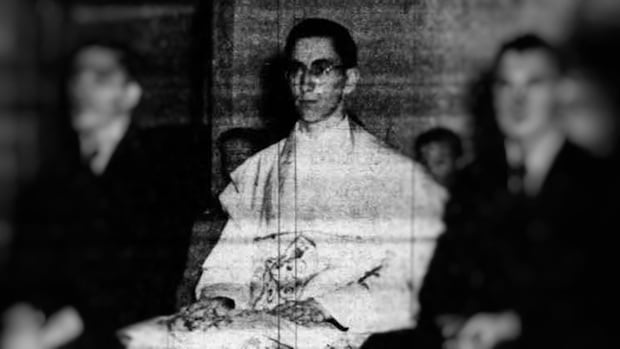
Father Kelly, originally from Windsor, was ordained in 1955. He was welcomed into the priesthood by Bishop O’Neill during a ceremony in his hometown, attended by 500 people “eager to honor the young cleric,” as reported by the Advertiser on June 9, 1955.
It remains unclear when he relocated to Baie Verte.
Three months after being directed to leave the parish, Bishop O’Neill commenced a correspondence with the Southdown Institute regarding Kelly’s progress. The initial letter references a psychiatric evaluation conducted post-admission, describing his actions as “rather pathetic homosexual adventures” driven by alcoholism.
“I do not believe the sexual incidents will lead to any future complications if this priest successfully manages to separate himself from alcohol,” it states.
The evaluator recommended that Kelly be reinstated to the priesthood within the Diocese of Grand Falls.
“It is believed that upon his return to ministry, Father Kelly should remain within the diocese as sexual issues represent only a minor aspect of his overall inability to adjust. Instead of being removed from his home diocese, he should receive substantial support in addressing his primary alcoholic challenges.”
Bishop O’Neill replied two weeks later, expressing reservations about this suggestion.
“It must be clear to him, as it is to me, that he was fortunate to exit Baie Verte with his name untarnished,” O’Neill wrote. “There could have easily been a court case with all its unpleasant ramifications. Even he should understand that it is not simply a matter of resuming where he left off.”
The bishop proposed that Kelly be temporarily transferred to Halifax.
“While I empathize with Father Kelly, as I would with any troubled priest, I cannot condone the gravity of his betrayal of trust and the significant scandal which, without the discretion of the family involved, could have tarnished the entire church in this small province.”
The response — written by Southdown’s executive director, John Kelly — nearly detailed the nature of the allegations against the priest, though without explicitly stating it.
“I am acutely aware that his behavior could have led to widespread scandal and I am thankful that this was averted,” the director wrote. “The more we engage with Father Kelly, the more we are convinced that he has the potential for a successful recovery. His motivation is strong, and it becomes increasingly clear that prolonged alcohol use had removed, as it often does, the constraints he would typically have exercised in his interactions with the boys involved.”
The director further suggested they find Father Kelly a position near the Southdown Institute in Ontario, allowing them to monitor him before he returns to Newfoundland.
O’Neill agreed and conveyed this to Father Kelly on July 30, 1970. They planned to start him in Ontario, he mentioned, before relocating him to Halifax with the intention of eventually bringing him back to Newfoundland.
“It is evident you were a very troubled and confused priest,” O’Neill wrote. “As it stands, we are all fortunate that the situation did not become public, resulting in irreversible damage to the Church and the priesthood. Now, thankfully, all that is behind us, and I look forward to your future contributions to the holy Priesthood.”
Kelly’s personnel records indicate he took on a pastoral role in Gander in 1977, later returning to Grand Falls-Windsor in 1983.
O’Neill passed away in 1974, not living to witness the repercussions of his decision to “forget the whole thing.”
Court filing seeks to uncover Winter Commission mystery
Kelly was among the initial group of Catholic clergy and Christian Brothers to face criminal charges in the late 1980s. What began as a trickle of accusations ultimately became a deluge, prompting Archbishop of St. John’s, Alphonsus Penney, to call for a commission of inquiry.
“It’s a great mystery to me how such a situation could persist for so long without anyone sounding the alarm,” Penney remarked to CBC News in 1989.
The Winter Commission report, released in 1990, revealed that allegations of sexual misconduct dated back as far as at least 1975 — when Penney himself sent a priest from the Diocese of Grand Falls to the Southdown Institute over pedophilia allegations. Penney did not report the priest to authorities, and the Winter Commission failed to uncover the priest’s identity.
Guardian Insurance is now requesting the court to compel Southdown to release its records concerning both the unnamed priest and Father Leonard Joseph Kelly.
“Guardian has a reasonable basis to suspect that the offending priest was Kelly, or alternatively another Grand Falls priest whose admission to Southdown was prompted by inappropriate interactions with a minor, thus the identification of the priests in Southdown’s records would be relevant to Guardian’s insurance investigation,” the company’s application states.

The Southdown Institute employs a team of psychologists and psychiatrists who primarily assist clergy dealing with various mental health issues, including alcoholism and depression. It has also treated priests accused of child abuse. (Southdown Institute website)
The Winter Commission discovered that church officials in Newfoundland and Labrador depended on Southdown for various reasons, starting with the unnamed priest in 1975.
The letters uncovered by Guardian Insurance indicate that this reliance existed at least five years earlier than previously documented.
In total, the Winter Commission report referenced five priests from Newfoundland who were sent to Southdown, four of whom faced accusations of inappropriate relationships with minors.
“The Southdown facility appears to have been viewed as a quick solution for nearly any type of behavioral issue,” the report noted.
The Southdown Institute remains operational today, providing psychotherapy, counseling, and spiritual guidance to clergy, lay pastoral ministers, and “all adults who view faith and spirituality as integral to their lives.”
Attorneys for Guardian Insurance, Southdown, and the Roman Catholic Episcopal Corporation of Grand Falls were present in court earlier this month for a brief session. A hearing regarding the application is scheduled for January 26, 2027.
Download our free CBC News app to sign up for push alerts for CBC Newfoundland and Labrador. Sign up for our daily headlines newsletter here. Click here to visit our landing page.