


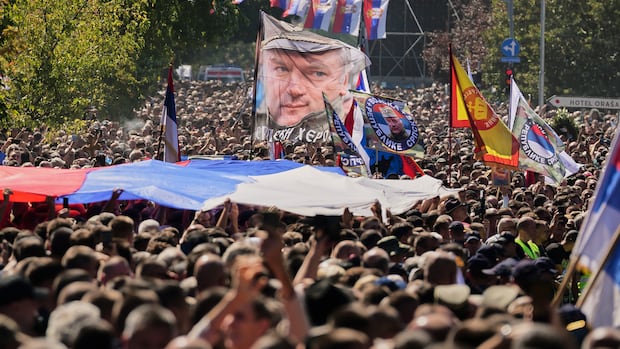

On Tuesday, leading officials of the European Union expressed their astonishment following Serbia’s decision to hold a hero’s funeral for Ratko Mladic, a Bosnian Serb general who passed away while serving a life sentence for war crimes. This incident has raised doubts about Serbia’s readiness to join the EU.
Mladic was interred in Belgrade on Monday with military honors. The funeral service was presided over by Patriarch Porfirije, the head of the Serbian Orthodox Church, while soldiers from the Serbian army carried his coffin, which was draped in a flag, at the cemetery.
Numerous ministers from the Serbian government attended the ceremony for Mladic, who is infamously known as the “Butcher of Bosnia” and was convicted of perpetrating the first genocide in Europe since World War II. He remains a figure of admiration for many Serbs.
European Commission President Ursula von der Leyen and European Council President Antonio Costa voiced their dismay through social media, stating, “The scenes from Ratko Mladic’s funeral yesterday in Belgrade were shocking.”
They further remarked, “The official support elements and the attendance of several senior Serbian officials at the funeral are profoundly regrettable. They reflect a failure to address a grim part of Europe’s recent history and contradict the principles that guide Serbia’s aspirations for EU membership.”
When asked about potential repercussions for Serbia’s EU membership application, a spokesperson for von der Leyen only commented, “We are assessing the situation.”
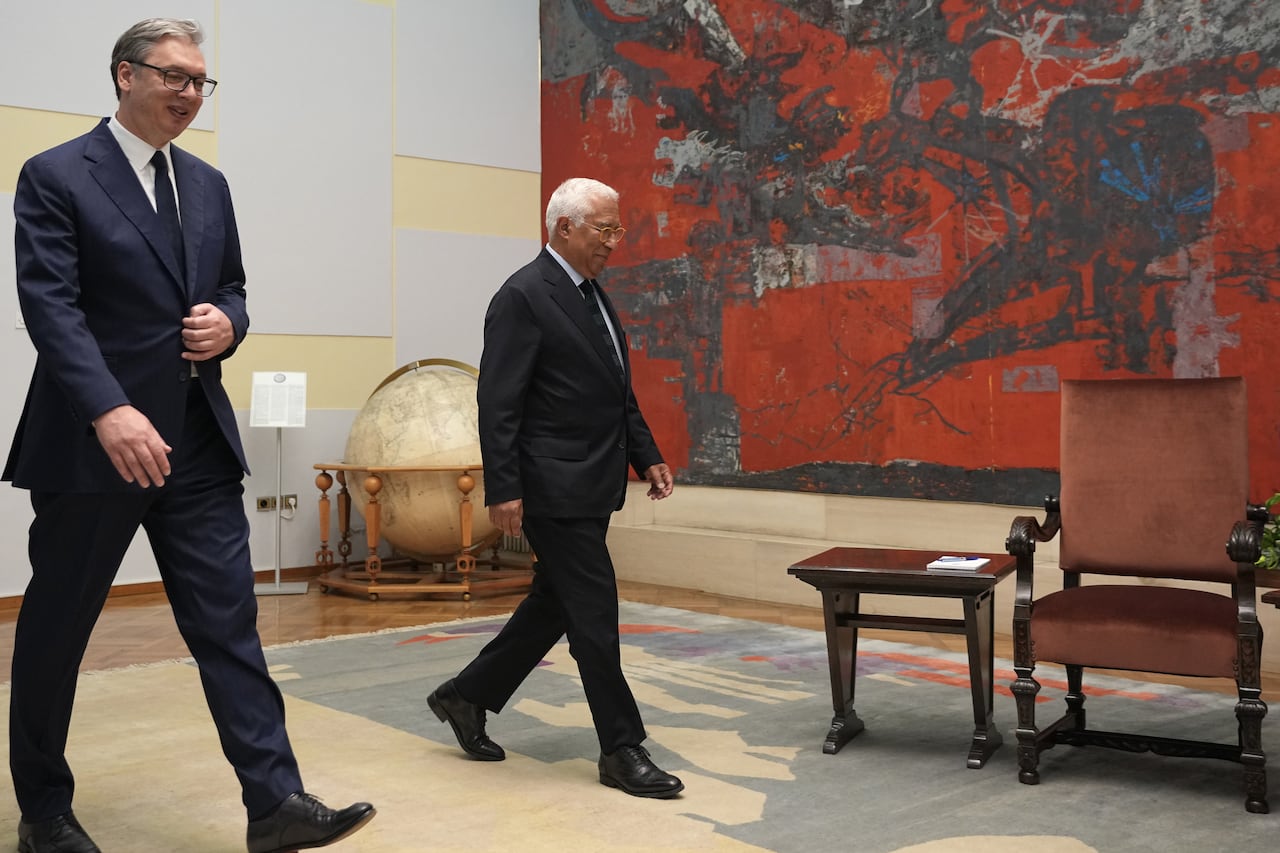
Serbian President Aleksandar Vucic, left, is shown with European Council President Antonio Costa prior to their meeting at the Serbia Palace in Belgrade on June 4. Costa was among the senior EU officials criticizing Serbian government officials attending Mladic’s funeral. (Darko Vojinovic/The Associated Press)
Although President Aleksandar Vucic did not attend the funeral, his son Danilo was present. Milorad Dodik, a nationalist leader from the Bosnian Serb community, as well as Russian ambassador to Serbia, Alexander Botsan-Kharchenko, were also in attendance.
Justice Minister Nenad Vujic was there, standing alongside Mladic’s family. He stated that authorities contributed to maintaining order during the funeral to ensure it proceeded “dignified,” while the family retained control over the proceedings.
The United Nations International Criminal Tribunal for the former Yugoslavia convicted Mladic of genocide for his involvement in the 1995 Srebrenica massacre, where around 8,000 Bosniak Muslim men and boys were killed after Bosnian Serb forces took over the UN-designated safe area.
He was also found guilty in connection with the 43-month siege of Sarajevo, which resulted in approximately 10,000 fatalities.
On Tuesday, the British government summoned Serbia’s chargé d’affaires to express its condemnation regarding the participation of Serbian state and military officials in Mladic’s funeral. The British Foreign Office issued a statement asserting that any glorification of the war criminal undermines reconciliation and regional stability in the Western Balkans.
Anticipated EU report weeks away
Vucic, once an extreme nationalist who backed Serbia’s expansionist ambitions during the conflicts that fragmented Yugoslavia in the 1990s, referred to the funeral as an “emotional outpouring.”
Navigating a delicate political balance, Vucic is attempting to garner support from his base—many of whom admire Mladic—prior to an early parliamentary election, all while avoiding alienation from the EU, which Serbia aspires to join.
EU Enlargement Commissioner Marta Kos cautioned last week that the funeral would serve as “a test” for Belgrade. She cancelled an upcoming visit to Serbia, arguing that “the glorification” of Mladic’s legacy would be at odds with EU principles.
Typically, the EU releases its annual enlargement report in late October or early November, detailing the progress of each candidate nation, including Serbia, towards membership and highlighting any shortcomings.
Von der Leyen is expected to visit the Western Balkans shortly before the report’s release. While she usually visits each country, specific dates for her trip have yet to be announced, and no agenda has been disclosed.
-
Ratko Mladic, war criminal and former Bosnian Serb military leader, dead
-
Thousands protest in Serbia even after President Aleksandar Vucic says he’ll resign
The funeral of Mladic is unlikely to bolster Serbia’s position. The country was already facing challenges regarding its membership prospects due to concerns over democratic regression. In April, Kos warned Belgrade that it risked losing access to approximately 1.5 billion euros ($2.4 billion Cdn) in EU funding amid growing worries about irregularities in municipal elections.
In Serbia’s favor, Vucic’s nationalist-populist SNS party maintains close connections with the EU’s largest political faction, the European People’s Party, which consists of center-right parties from across Europe. The EPP has faced accusations of shielding Vucic.
“The European People’s Party must cease providing a safe haven for the SNS party, which openly celebrates convicted war criminals and welcomes the ‘Butcher of Bosnia’ with open arms,” stated Slovenian Green MEP Vladimir Prebilic last week.
Von der Leyen is a prominent member of the EPP, as is half of her team of policy commissioners and European Parliament President Roberta Metsola. Notably, von der Leyen has refrained from publicly criticizing Vucic.
For many years, the EPP firmly supported Hungarian Prime Minister Viktor Orbán’s nationalistic Fidesz party, aiming to keep him within the political mainstream of Europe. However, the EPP ultimately suspended Fidesz in 2019 due to concerns regarding democracy and the rule of law in Hungary, and Fidesz left the group in 2021.