


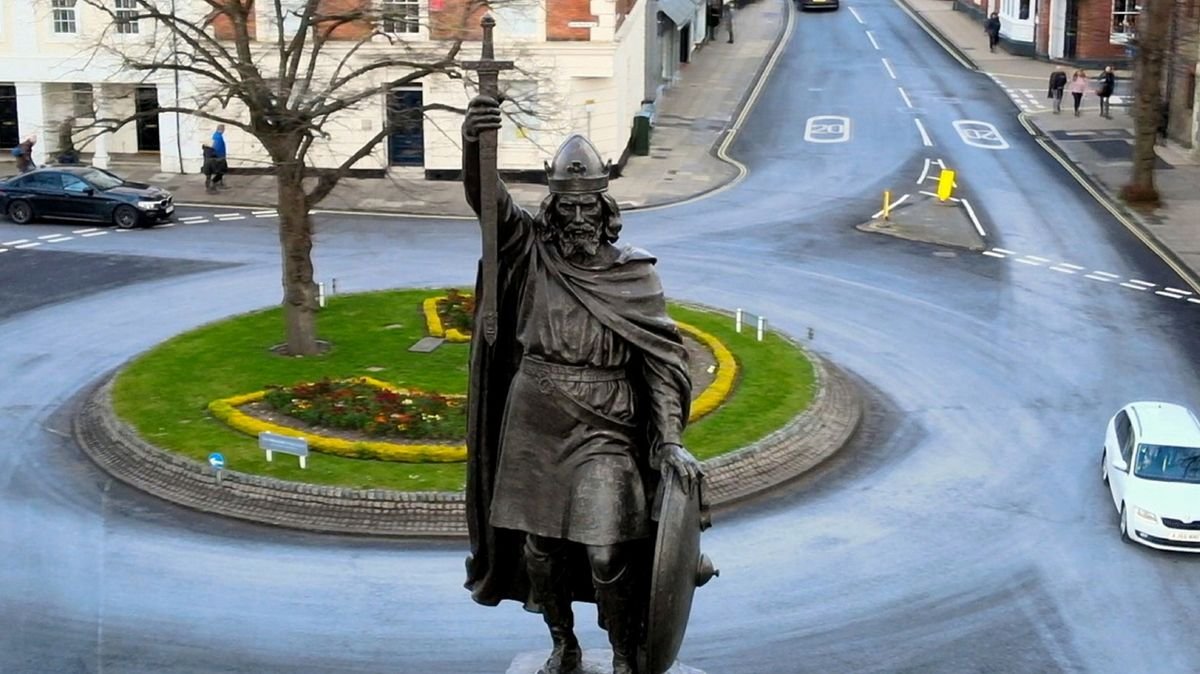

Researchers have made a stunning claim that they have located the long-lost remains of King Alfred the Great buried beneath a car park.
Alfred the Great, the renowned English monarch often hailed as the country’s founding ruler, has had his final resting place a subject of mystery despite his significant historical stature.
After a 13-year investigation, author and historical researcher Graham Phillips claims to have unearthed Alfred’s grave. The revelation is set to be disclosed on an upcoming episode of the TV series Weird Britain airing on Blaze TV this Wednesday at 9pm.
Phillips stated that the location is approximately 20 yards from a marker indicating Alfred’s previous burial spot. He noted the unusual coincidence that, like Richard III, Alfred’s remains were discovered beneath a car park. Alfred passed away in 899, and his remains had been relocated multiple times.
Initially interred at Winchester Cathedral, Alfred’s bones were later transferred to Hyde Abbey in Winchester in 1110, where they were laid to rest near the high altar alongside his wife and son. However, the abbey was eventually demolished in 1539 following the dissolution of the monasteries, leaving the site in ruins.
In 1866, during the construction of a workhouse, antiquarian John Mellor excavated what he believed to be Alfred’s remains and reburied them at St. Bartholomew’s Church nearby. However, a subsequent examination in 2013 revealed that the bones dated over 200 years past Alfred’s death, igniting Phillips’ interest and subsequent search.
Phillips expressed, “The bones found in St. Bartholomew’s churchyard were not Alfred’s. This spurred my 13-year quest to uncover their true fate.”
Previously assumed to have been lost during the 1860s construction, it is now believed that Alfred’s bones, along with those of his wife and son, were relocated before that time. Winchester city council transformed the Hyde Abbey site into a picturesque garden, with markers indicating the previous burial sites.
Phillips revealed, “Research showed that in 1788, a prison was built nearby, and the graveyard area was converted into a garden for the prison warden’s residence. I am convinced the original remains were moved during that period.”
In the late 1700s, historian Henry Howard sought out Richard Page, the warden overseeing work at Hyde Abbey, to obtain plans of the pre-prison ruins. During Phillips’ search for these plans at Cambridge University’s archives, he made a remarkable discovery.
Phillips elaborated, “Howard’s writings in Archaeologia’s Volume 13 from 1800 detail prisoners tasked with landscaping the warden’s new garden, unearthing bones that were reinterred nearby, complete with a map.”
Make Daily Mirror