


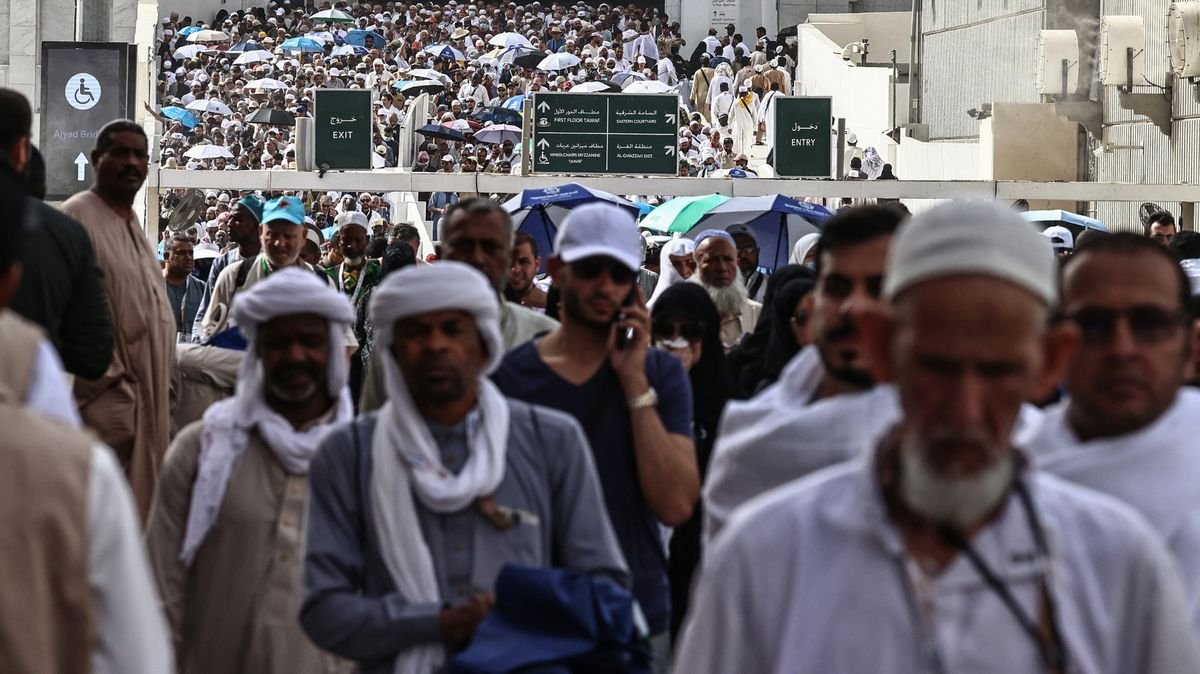

More than 1.5 million Muslims have gathered in Saudi Arabia for the annual Hajj pilgrimage, which is renowned as one of the largest religious gatherings globally.
Each year, numerous worshippers journey to the sacred city of Mecca to participate in the revered pilgrimage, a fundamental tenet of Islam that many Muslims aspire to complete at least once in their lifetime.
During several days, pilgrims engage in essential rituals, such as encircling the holy Kaaba – a cubic stone structure draped in black cloth at the heart of Mecca’s Grand Mosque – and convening at Mount Arafat for prayers and contemplation.
The pilgrimage occurs during Dhul Hujjah, the final month of the Islamic calendar, with the Day of Arafah, an Islamic holiday, commencing on Tuesday.
This year’s Hajj coincides with significant regional tensions stemming from the conflict between the US, Israel, and Iran.
Hajj, an Arabic term signifying “to intend a journey” or “to set out with a specific purpose,” has historical roots tied to Prophet Abraham (Ibrahim) and his son Ishmael (Isma‘il), who, according to Islamic tradition, were instructed by God to construct or reconstruct the Kaaba in Mecca.
The pilgrimage customs associated with Hajj are perceived in Islam as being reintroduced and formalized by the Prophet Muhammad in the 7th century CE.
Touching the sacred Kaaba symbolizes a profound act of reverence for Muslims. While not worshipping the structure itself, many individuals touch its surface to adhere to the traditions of Prophet Muhammad and honor the prophetic legacy.
The act of touching the Kaaba is believed to bestow spiritual blessings and facilitate the forgiveness of sins.
Hajj unfolds through a sequence of sacred rites performed over several days in and around Mecca, each marking a distinct phase of the spiritual expedition.
Step 1: Ihram (initiating the pilgrimage) – Pilgrims assume a state of spiritual purity, donning plain white attire and declaring their intent to undertake Hajj.
Step 2: Tawaf (circling the Kaaba) – Worshippers circumambulate the Kaaba seven times in the Grand Mosque in Mecca.
Step 3: Sa’i (walking between Safa and Marwah) – Pilgrims traverse between two hills, repeating a historical act of devotion.
Step 4: Mina (the tent city) – Millions congregate in an expansive encampment outside Mecca, engaging in prayer and reflection.
The Hajj journey continues with various steps on subsequent days, culminating in the completion of the pilgrimage rituals.
Muslims worldwide are converging on the holy city of Mecca, where nearly two million worshippers will embark on the annual Hajj pilgrimage, a central obligation of Islam known as one of the Five Pillars.
Hajj symbolizes unity, devotion, and offers Muslims an opportunity to seek spiritual purification and fortify their faith.
Congregational prayers are pivotal during Hajj, with worshippers uniting in vast numbers to pray together across Mecca’s sacred sites, fostering community and spiritual bonds.
The pilgrimage to Mecca is a significant religious obligation for adult Muslims who possess the physical and financial means, with the journey mandated to be undertaken at least once in their lives.
As temperatures soar in Mecca, pilgrims are advised to shield themselves with umbrellas, stay well-hydrated, and avoid peak outdoor hours to combat the scorching heat.
Hotels, airports, and roads are witnessing a surge in activity as pilgrims continue to arrive in Mecca for Hajj, with volunteers distributing water bottles and providing cooling mist sprays to assist worshippers in coping with the intense heat.
The ongoing Hajj pilgrimage unfolds against a backdrop of diplomatic efforts aimed at addressing broader Middle East tensions and concerns regarding Iran’s nuclear program.
The pilgrimage experience is described as an arduous yet meaningful journey by many participants, with the hope that their intentions and actions will be accepted by the Divine.