


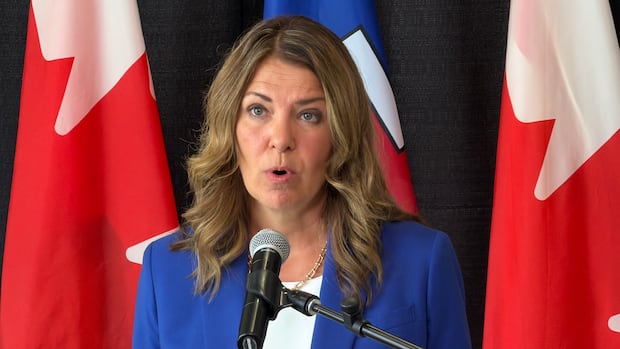

Danielle Smith, the Premier of Alberta, asserts that Canadians need to intensify their diplomatic initiatives to persuade U.S. lawmakers and the public that the rising trade conflict is harmful to both nations.
“Being more Canadian means being exceedingly friendly, kind, and helpful to the point of being irresistible,” Smith stated during a news conference in Grande Prairie, Alberta, on Wednesday. The U.S. imposed a range of new tariffs on Canadian products this past Saturday.
According to Smith, only pressure from U.S. governors, congressional members, and the American populace can influence the perspective of President Donald Trump’s administration regarding its tariff strategies.
“Canada is not going to prevail in this struggle through sheer force,” she remarked. “Our victory will come from being more intelligent, strategic, adaptable, and leveraging our reputation and relationship with the American people to reverse these tariffs.”
Smith also countered suggestions from Ontario Premier Doug Ford, former conservative Alberta premiers Jason Kenney and Alison Redford, as well as Alberta NDP Leader Naheed Nenshi, to use Canadian oil and gas—mainly from Alberta—as leverage in the trade dispute.
Smith depicted a grim scenario regarding the potential fallout from implementing significant counter-tariffs on oil, a large portion of which is transported to U.S. refineries.
“I cannot imagine a more catastrophic policy decision than to cut off or impose taxes on Alberta’s oil exports to the United States,” she expressed.
Smith believes that the U.S. would retaliate immediately with punitive tariffs on oil and gas, affecting Canadian oil that transits through the U.S. to reach Eastern Canada and imposing tariffs that would have repercussions on refined fuels purchased by the eastern provinces from the U.S.
Her apprehensions mirrored those of Saskatchewan Premier Scott Moe, who also cautioned that oil and gas counter-tariffs would increase gas prices in Eastern Canada.
Unlike the U.S., Canada does not possess strategic oil reserves, Smith noted.
“This would bring the economies of Ontario and Quebec to a standstill,” she added.
In the long run, Smith cautioned that leveraging energy as a bargaining tool could result in Canada permanently losing the U.S. as an oil buyer, leading the nation to seek cheaper crude from places like Venezuela.
Smith stated this scenario could wipe out hundreds of thousands of jobs, create fuel shortages that would ground airplanes, and cause a significant drop in the Toronto Stock Exchange and the value of Canadians’ investments.
Paul Chastko, a history professor at the University of Calgary with expertise in the North American petroleum sector, mentioned that while it’s premature to predict the outcomes of using oil as leverage, Smith’s concerns regarding its impact on the Canadian economy might hold validity.
Chastko pointed out that Canada’s lack of strategic oil reserves has historically contributed to instability in the domestic energy sector.
“If I were in her position, I would focus on minimizing volatility in the province to ensure predictability,” he suggested in an interview.
“Her tactics and strategy imply the expectation that the trade relationship between Canada and the United States will eventually return to its previous state.”
Chastko expressed uncertainty regarding the permanence of Trump’s influence on the North American oil industry, but emphasized the necessity for provincial and federal governments to explore alternative strategies for international trade.
Emphasis on internal trade barriers
During her remarks to the media on Wednesday, Smith urged the federal government to hasten the approval process for a new bitumen pipeline to the West Coast and to implement tax reforms that encourage investment within Canada.
She called on fellow Canadian premiers to agree without delay to a uniform markup for all Canadian-produced alcoholic beverages across the country.
“No more protectionism,” Smith declared. “Stop discussing it and take action.”
Smith announced the establishment of a new cabinet committee focused on tariffs, co-chaired by Finance Minister Jason Nixon and Jobs, Economy, Trade and Immigration Minister Joseph Schow, to evaluate the province’s response to the new tariffs.
She stated that the province will create an online platform for businesses to provide feedback and form a business advisory committee.
Smith mentioned that the cabinet committee would evaluate a proposal made by Moe on Wednesday, which involves a 50 percent tax on U.S. alcohol products as an informal counter-tariff.
Currently, Saskatchewan and Alberta are the only provinces permitting U.S. liquor sales amidst the trade dispute.
Smith’s position within Team Canada
Elizabeth Smythe, a political science professor emeritus at Concordia University of Edmonton, commented in an interview with CBC News that she believes Smith is addressing concerns regarding her commitment to what some politicians refer to as “Team Canada” by highlighting the economic damage that oil counter-tariffs would inflict on Eastern Canada.
“She aims to position her resistance within a broader national context,” Smythe explained.
Other provincial leaders might view her message with skepticism, recognizing that Smith’s primary role is to advocate for Alberta’s interests, according to Smythe.
“It remains uncertain how the Trump administration might react, but she presumes they would respond in a manner that she claims would negatively affect the rest of Canada,” she added.
Smythe suggested that Smith is also attempting to redirect criticism from other moderate conservative leaders and alleviate doubts about her commitment to Canada.
In a statement released on Wednesday, Nenshi reiterated his party’s demands for government action.
“We need decisive actions and tough choices right now,” he stated. “Ban American alcohol and cancel the referendum.”
“For over a year, we have emphasized the necessity to strengthen Canadian markets, cultivate a more strategic partnership with the United States, diversify our global trade relationships, attract international talent, and, most importantly, safeguard Alberta’s workforce.”
On Wednesday, Smith reaffirmed her commitment to moving forward with a provincial referendum set for October 19, which will include a question about whether Alberta should remain part of Canada or initiate a process for a binding separation referendum.
“This is a crucial moment for us to recognize the advantages of being a part of Canada,” Smith remarked. “That is my advocacy. That is why I intend to vote to remain [in Canada].”
Smith reiterated her call for the federal government to reengage in negotiations with the U.S. prior to the implementation of Canadian tariffs on $27.6 billion worth of U.S. goods, which are set to take effect in approximately two weeks.