


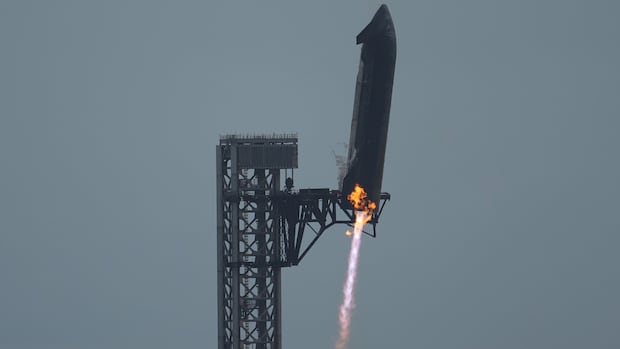

On Saturday, SpaceX’s Starship successfully returned to Earth, being captured midair by colossal mechanical arms at the same location where its journey commenced 22 hours prior.
This marked the spectacular conclusion that Elon Musk and his team envisioned — the inaugural retrieval of a Starship reentering from space. However, following the explosion of the first-stage booster shortly after liftoff from Texas on Friday, the company was unable to achieve its ambitious goal of a double recovery, which remains essential for expediting travel to the Moon and Mars.
Debris was left in the Gulf of Mexico, cordoned off with buoys, while the stainless steel, bullet-shaped vehicle righted itself at the launch pad.
The thrilling, science fiction-esque capture overshadowed the earlier mishap with the booster. Cameras captured images of the spacecraft as it hung above the ground, supported by the launch tower’s arms.
“Can you believe it?” exclaimed SpaceX commentator Dan Huot, elongating each syllable. “Look at her! Baby, she’s back!”
Describing the day as “epic,” Musk later climbed the launch tower to capture video footage with his phone, even embracing the spacecraft. “Looks great,” he shared on X.
SpaceX officials stated that Saturday’s successful catch illustrates the complete reusability of Starship, a critical factor for fast and cost-effective recycling. Despite the failure of Friday’s booster recovery, the company had previously accomplished three successful booster captures, demonstrating the viability of the technique.
NASA applauded the developments on Saturday. The agency is investing billions into Starship to facilitate Artemis astronauts’ moon landings later this decade and to assist in establishing a permanent lunar base. Musk’s aspirations extend even further: he envisions deploying a fleet of Starships to construct a city on Mars.
“It was nearly magical,” commented NASA Administrator Jared Isaacman via X. “Making more believers by the day … one step closer to (emojis of the moon and the U.S. flag).”
The largest and most powerful rocket in the world — a 124-meter giant — ascended late Friday afternoon from SpaceX’s Starship facility near the U.S.-Mexico border. After separating cleanly from its booster before complications arose, the upper-stage spacecraft ascended into orbit and deployed 26 advanced Starlink satellites.
Starship continued to orbit the Earth at an altitude of 265 kilometers, with live feeds of both itself and the planet being transmitted via Starlink. The spacecraft completed 14 orbits around Earth, surpassing the previous mission’s one to two laps.
This was SpaceX’s 15th full-scale Starship flight since 2023 and its second trip to orbit.
SpaceX reported that all systems on the spacecraft, including its crucial heat shield, functioned effectively.
Regarding the booster, SpaceX’s Kate Tice noted that its engines ceased operation too soon during descent. The booster’s guidance system detected an improper position and automatically initiated a descent into the ocean and self-destruction. Engineers continue to investigate the underlying cause.
SpaceX anticipates beginning Starship launches from Florida’s Kennedy Space Center in the coming months. This site will serve as the launch point for NASA’s next Artemis mission, which will orbit Earth for lunar lander practice without landing on the moon.
Artemis III’s four astronauts will attempt to dock their capsule with both Starship and Blue Origin’s Blue Moon, as the two companies will alternate in transporting crews to the lunar surface. NASA aims for Artemis IV to take place as early as 2028, marking humanity’s first moon landing since the Apollo era over fifty years ago.