


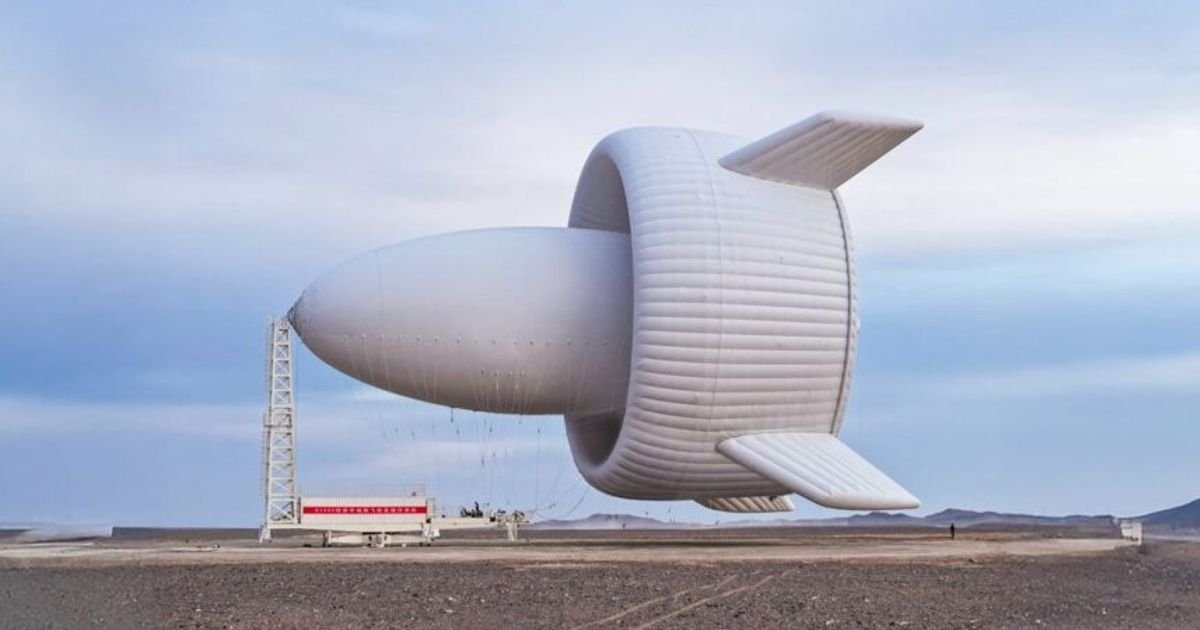

China recently developed a novel airborne wind turbine that hovers in the sky. This innovative high-altitude contraption, resembling an airship, has successfully completed its inaugural test by soaring at 2,000 meters and connecting to the national power network.
Known as the S2000 Stratosphere Airborne Wind Energy System (SAWES), this technology aims to harness the stronger and more consistent winds prevalent at altitudes beyond traditional ground-based turbines. The recent test marked a significant advancement in aerodynamic and structural design for large unconventional aerial vehicles. In a 30-minute ascent, the system generated 385 kilowatt-hours of electricity, marking a significant achievement for a device categorized as ‘megawatt-class.’
Measuring approximately 60 meters in length, 40 meters in width, and 40 meters in height, the S2000 operates by producing power in the air and transmitting it to the ground through a cable for integration into the grid. Weng Hanke, the co-founder and chief technology officer of Beijing Linyi Yunchuan Energy Technology overseeing the project, emphasized the unique airborne power generation approach, stating, “Traditional turbines rotate their blades on the ground; we perform the same function in the sky.” Additionally, he highlighted the system’s capabilities beyond power generation, including the ability to support communication and monitoring tasks.
Airborne wind energy has long been lauded for its potential to access more reliable winds with minimal land requirements. However, transitioning from prototype to dependable grid-scale operation has been challenging for the sector. The successful grid connection test at the megawatt scale conducted by China’s S2000 represents a significant step towards practical implementation, particularly in urban or densely populated areas where conventional towers face constraints due to land scarcity and turbulence issues.
Despite this progress, several obstacles need to be addressed before widespread commercial deployment can occur. These include securing safety certification for shared airspace, ensuring system durability in adverse weather conditions, streamlining launch and retrieval processes, and validating year-round reliability and maintenance efficiency.
Nonetheless, for nations striving to reduce carbon emissions in urban settings, an airborne solution like the S2000 could complement existing renewable energy sources such as rooftop solar and offshore wind, thereby minimizing visual and land-use impacts. Future trials for the S2000 will focus on enhancing flight duration, increasing power output, and integrating additional functionalities like emergency communication services.